What a Sourdough Discard Recipe Can and Can't Do
Sourdough discard is the portion of starter you scoop out and set aside before a feeding — the part most bakers used to pour down the drain. It is still flour and water that has fermented, so it carries lactic and acetic acids, a little residual yeast activity, and a lot of flavor. What it does not carry is enough strength to raise a loaf on its own.
That is the whole idea behind baking with discard. In a quick bread, baking powder and baking soda supply the lift; the discard supplies tang, moisture, and a softer crumb. If you want a tall, open sourdough loaf, feed your starter and bake with active starter instead. If you want muffins on a Tuesday morning with the jar that is already sitting in the fridge, discard is exactly the right ingredient.
The other thing discard brings is acid. That matters because acid reacts with baking soda to produce carbon dioxide — a fast, reliable rise. It also means you cannot treat discard as an equal swap for milk or buttermilk without thinking about the chemistry.
Check the Discard Before It Goes in the Bowl
Discard lives in the fridge, so it is usually cold and may look flat. Flat is fine. Bubbly is fine. What you want to judge is whether it is still good.
- Smell: clean, sour, and a little like yogurt or beer. If it smells rotten or like nail polish remover, start over.
- Color: gray-beige with a dark liquid on top is normal. That liquid is hooch, the alcohol byproduct of fermentation. Stir it in for a tangier bake or pour it off for a milder one.
- Trouble signs: fuzzy mold, pink, orange, or green streaks, or a sharp chemical smell. Discard the whole jar and build a fresh starter.
Hooch tells you the starter has been waiting a while, and the longer it waits, the more acidic it becomes. Old, very sour discard is wonderful in biscuits and crackers, where tang is the point. In a delicate muffin or snack cake, fresher discard — from the past week or two — keeps the flavor in balance. Most home starters sit at 100% hydration, which simply means equal weights of flour and water; that assumption makes the math below easy.
The Swap Ratio for Quick Breads and Muffins
Here is where a discarded jar becomes a real recipe. One cup (240 g) of 100% hydration discard is roughly 120 g of flour plus 120 g of water. So when you add discard, you are adding both an ingredient and a liquid, and the recipe has to make room for it.
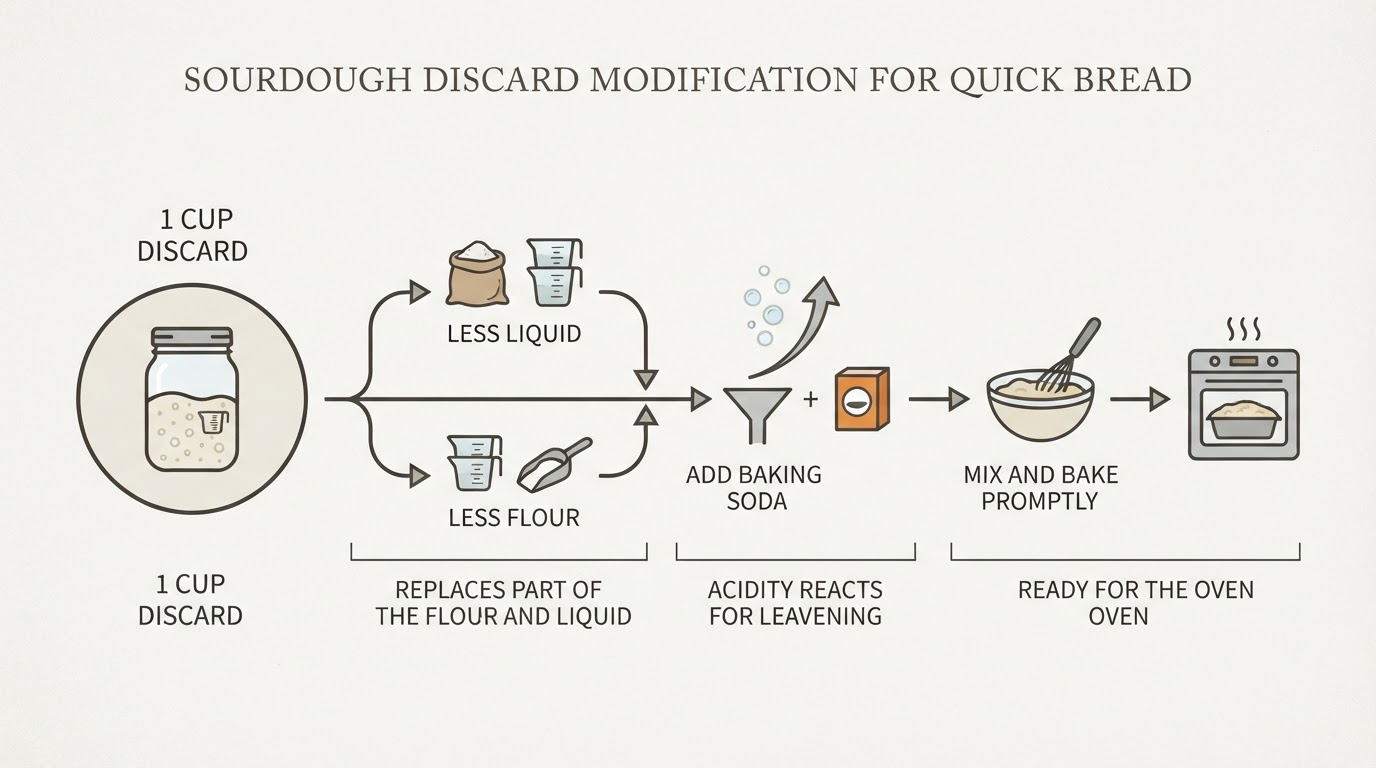
Start with the liquid. For every 1 cup (240 g) of discard you use, pull about 1/2 cup (120 g) of milk, water, or buttermilk out of the recipe. Then hold back a few tablespoons of the flour and add it only if the batter looks slack; muffin batter should be thick enough to mound on a spoon, not pourable like pancake batter.
Then fix the leavening. Keep the recipe's baking powder — about 1 teaspoon per cup of flour is a solid default — and add about 1/2 teaspoon of baking soda per cup of discard. Baking soda neutralizes the acid and gives you a quick lift; without it, a very sour discard can taste sharp and the crumb can stay heavy. More soda is not better. Too much leaves a soapy, metallic edge that no amount of chocolate chips will hide.
Bake | How much discard | What to change |
|---|---|---|
Muffins or a quick loaf (2 cups flour) | 1 cup (240 g) | Cut the added liquid by 1/2 cup; keep 2 tsp baking powder; add 1/2 tsp baking soda |
Pancakes or waffles (1 cup flour) | 1/2 to 1 cup | Thin with milk until pourable; add 1/2 tsp baking soda; let the batter rest 10 minutes |
Biscuits or scones (2 cups flour) | 3/4 cup | Use discard as the buttermilk; cut in cold butter; handle the dough as little as possible |
Crackers (1 cup flour) | 1 cup | No leavening needed; roll paper-thin and bake until crisp |
A small scoop (1/4 to 1/2 cup) | 1/4 to 1/2 cup | Usually no other changes; add a pinch of baking soda if the discard is old |
Two more habits separate a tender bake from a tough one. First, mix until the flour just disappears — lumps are allowed. Overmixing develops gluten, and a developed quick bread bakes up dense and tunneled. Second, bake promptly. Once the baking soda meets acid, the reaction is underway; a batter that sits on the counter loses lift before it reaches the oven.
A Master Sourdough Discard Muffin Formula
This is the formula to memorize. It makes 12 standard muffins and takes about 35 minutes from the moment you open the fridge.
Dry ingredients
- 240 g (2 cups) all-purpose flour
- 150 g (3/4 cup) granulated sugar
- 2 teaspoons baking powder
- 1/2 teaspoon baking soda
- 1/2 teaspoon fine salt
Wet ingredients
- 240 g (1 cup) sourdough discard, 100% hydration
- 2 large eggs
- 80 g (1/3 cup) neutral oil, or 113 g (1/2 cup) melted butter, cooled slightly
- 1 teaspoon vanilla extract
- 1 cup (about 170 to 200 g) mix-ins: chocolate chips, blueberries, chopped nuts, or dried fruit
- Heat the oven to 375°F (190°C) and line a 12-cup muffin pan.
- Whisk the dry ingredients in a large bowl.
- Whisk the discard, eggs, oil or butter, and vanilla in a second bowl until smooth. The mixture will look a little curdled; that is normal.
- Pour the wet into the dry and fold with a spatula just until the flour disappears. Fold in the mix-ins with the last few strokes.
- Divide the batter among the cups, filling each about three-quarters full. If the batter looks thinner than muffin batter should, sprinkle in flour a tablespoon at a time until it mounds on the spoon.
- Bake 18 to 22 minutes, until the tops are domed and a toothpick inserted in the center comes out with a few moist crumbs. A quick-read thermometer in the middle of a muffin should read about 200°F (93°C).
- Cool in the pan 5 minutes, then move the muffins to a rack.
Easy variations. Blueberries plus the zest of one lemon; chocolate chips plus a pinch of espresso powder; chopped apple plus cinnamon and nutmeg; cheddar, cornmeal, and chives for a savory version that works next to soup. The same batter can become a loaf: bake it in a greased 9-by-5-inch pan at 350°F (175°C) for 45 to 55 minutes.
More Quick Bakes for a Full Discard Jar
Pancakes and waffles. Whisk 1 cup discard, 1 cup all-purpose flour, 1 cup milk, 1 egg, 2 tablespoons melted butter, 2 teaspoons baking powder, 1/2 teaspoon baking soda, 1 tablespoon sugar, and a pinch of salt. Let the batter rest 10 minutes while the griddle heats — the flour hydrates and the batter thickens. Cook as usual. Waffles benefit from a slightly thicker batter; use 3/4 cup milk.
Biscuits and scones. Cold butter is the rule. Cut 1/2 cup cold butter into 2 cups flour with 1 tablespoon baking powder, 1/2 teaspoon baking soda, and 1 teaspoon salt, then add 3/4 cup discard and stir just until the dough comes together. Pat, fold twice, cut straight down, and bake at 425°F (220°C) for 12 to 15 minutes.
Crackers. Stir 1 cup discard, 1 cup flour, 2 tablespoons softened butter or olive oil, and 1/2 teaspoon salt into a soft dough. Rest 20 minutes, roll as thin as you can, cut into squares, and bake at 350°F (175°C) for 15 to 20 minutes, flipping once, until crisp and browned at the edges.
Cornbread and savory quick breads. Swap the buttermilk in your usual cornbread for discard cup for cup, add 1/2 teaspoon baking soda, and bake in a hot buttered skillet. The tang cuts through the sweetness and the crust comes out deep gold.
Snack cakes and banana-style loaves. Very ripe bananas, applesauce, or pumpkin already bring moisture, so use a little less discard — about 3/4 cup for a standard loaf — and expect a slightly longer bake. The reward is a loaf that tastes aged in the best way.
If you want a crusty, open-crumb loaf rather than a quick bake, this is not the recipe family for it. Feed the starter, wait for it to double, and bake with active starter. Discard shines in the fast lane.
When the jar is full and you want to bake right now, The Rustic Bakehouse keeps a Quick Breads collection built around exactly that: baking-powder-leavened muffins and quick loaves, including a sourdough discard chocolate chip muffin for the days when the starter needs feeding and breakfast needs to happen.

Sourdough tag collection first screen: breadcrumb, H1 'Sourdough', and 4-column sourdough-recipe card grid with pagination.
When a Discard Bake Goes Wrong
Dense and gummy. Usually overmixing, too much discard, or an underbake. Fold less, measure the discard by weight, and trust the toothpick and the 200°F center.
Soapy or metallic. Too much baking soda. Pull back to 1/2 teaspoon per cup of discard and bake the batter right away.
Flat muffins. The leaveners are old, the batter sat too long, or the oven was not fully preheated. Check the date on the baking powder and set a timer after the oven beeps.
Aggressively sour. The discard was very old, or the recipe used hooch that had been sitting for weeks. Use fresher discard, pour off the hooch, or add a spoonful of sugar or honey to round out the edge.
Dry and crumbly. The flour went in without the liquid coming out. Measure discard by weight and hold back flour until the batter tells you it is done.
Freezing Discard Bakes and the Discard Itself
Freezing is what makes a discard habit sustainable. Bake once, eat some, freeze the rest.
Muffins and scones. Cool completely, wrap each one tightly, then store them in a freezer bag with the air pressed out. They keep two to three months. Reheat one straight from frozen in the microwave for 30 to 45 seconds, or wrap it in foil and warm it at 300°F (150°C) for 8 to 12 minutes.
Quick loaves and snack cakes. Slice before freezing — you will thank yourself later — and slide a strip of parchment between the slices. The whole loaf goes into a bag or a rigid container for up to three months. Toast single slices from frozen.
Pancakes and waffles. Freeze them flat on a sheet pan first so they do not clump, then transfer to a bag. They reheat in a toaster in a couple of minutes.
Crackers and biscuits. Baked biscuits freeze well for about two months; unbaked ones can be frozen on a sheet pan, bagged, and baked from frozen with a few extra minutes in the oven. Crackers soften in the freezer, so refresh them on a sheet pan at 300°F (150°C) for 5 minutes before serving.
Discard itself. When even baking cannot keep up, freeze the discard in 1-cup portions — silicone trays and zip-top bags both work — and thaw a portion overnight in the fridge. It will separate a little; stir it back together before it goes into the bowl. Label everything with the date. Refrigerated discard is best used within a week or two of its last feeding; beyond that, it belongs in a biscuit or the freezer.
Common Questions About Sourdough Discard Recipes
Do I have to feed the starter first?
No. Discard is the jar's overflow. Feed the starter after you take the discard out, then let the jar rest while your muffins bake.
Can I use discard straight from the fridge?
Yes. If the recipe's other ingredients are cold, let the discard sit on the counter for 20 to 30 minutes so the batter does not go into the oven chilled.
How long does discard keep?
In the fridge, about one to two weeks between feedings. Older discard is more acidic and better suited to biscuits, crackers, and pancakes than to delicate cakes.
What if my starter is not 100% hydration?
Adjust with the same math. A thick starter carries more flour, so add a splash more liquid; a thin starter carries more water, so hold back liquid and add flour a tablespoon at a time.
Can discard replace the liquid in any recipe?
Not blindly. It works best in recipes that already call for buttermilk, milk, or water, and it cannot carry the rise in a yeasted bread. Start with quick breads and adjust from there.
Why do I need baking soda if I add baking powder?
Baking soda neutralizes the acid in the discard and adds a fast lift. Baking powder gives you a reliable backup rise. Together they keep the crumb tender and the flavor balanced.
That is the whole loop: keep the discard, mix it into a quick batter, bake, and freeze the extra. The jar stops being a chore and starts being the reason to turn on the oven.