What Makes a Drop Sugar Cookie Different
A drop sugar cookie recipe is forgiving by design. The dough stays soft enough to scoop, and the oven does the shaping: each mound slumps into a round, lightly domed cookie with a few fine cracks across the top. No rolling pin, no cutters, no floury counter.
That soft dough is what separates a drop sugar cookie from the rolled kind. Rolled sugar cookie dough is stiff and floury because it has to hold an edge through chilling, rolling, and cutting. Drop dough carries more butter and less flour, so it bakes up tender rather than snap-crisp. The texture to aim for is a soft, faintly chewy middle with a thin crisp rim, soft enough to bend and sturdy enough to stack.
It is also not a snickerdoodle, even though the two look alike on the cooling rack. Snickerdoodles get cream of tartar and a cinnamon sugar coat. A plain drop sugar cookie gets vanilla and a roll in granulated or coarse sugar.
Ingredients for Drop Sugar Cookies, and What Each One Does
Ingredient | Amount | What it does |
|---|---|---|
Unsalted butter, softened | 1 cup (227 g) | Fat, flavor, and lift. Creaming it with sugar traps air that the oven expands. |
Granulated sugar | 1 cup (200 g) | Sweetness, tenderness, and browning. |
Large egg | 1 | Binds the dough, adds moisture, and helps the surface brown. |
Vanilla extract | 2 teaspoons | The flavor backbone. |
All-purpose flour | 2¾ cups (330 g) | Structure. This is the amount that decides whether the cookies hold their shape or spread. |
Baking powder | 1 teaspoon | The main lift. |
Baking soda | ½ teaspoon | Helps the edges brown and the dough relax. |
Fine salt | ½ teaspoon | Keeps the sweetness from tasting flat. |
Sugar for rolling (optional) | ⅓ cup (67 g) | The crackly top. Coarse sugar stays visible; granulated mostly melts in. |
Two details matter more than the list itself. Measure flour by weight when you can, because a cup scooped straight from the bag can pack in far more flour than a spooned-and-leveled cup, and heavy flour is the usual reason drop cookies turn out dry and cakey. Butter should sit at cool room temperature: soft enough to take a light fingerprint, still matte, not greasy at the edges. Butter that has started to melt cannot hold air, and the cookies will spread before they set.
Equipment Checklist
None of this is specialty gear, and you can make the dough with a bowl and a sturdy spoon if that is what you have.
- Two large baking sheets. Light-colored metal browns the bottoms more slowly than dark nonstick.
- Parchment paper, so you are not greasing pans between batches.
- A hand mixer or stand mixer, or a whisk and some patience.
- Measuring cups and spoons, or a kitchen scale for the flour.
- A 1½-tablespoon cookie scoop, or a regular tablespoon.
- A wire cooling rack.
- An oven thermometer, if your cookies brown unevenly from batch to batch.
How to Make Drop Sugar Cookies, Step by Step
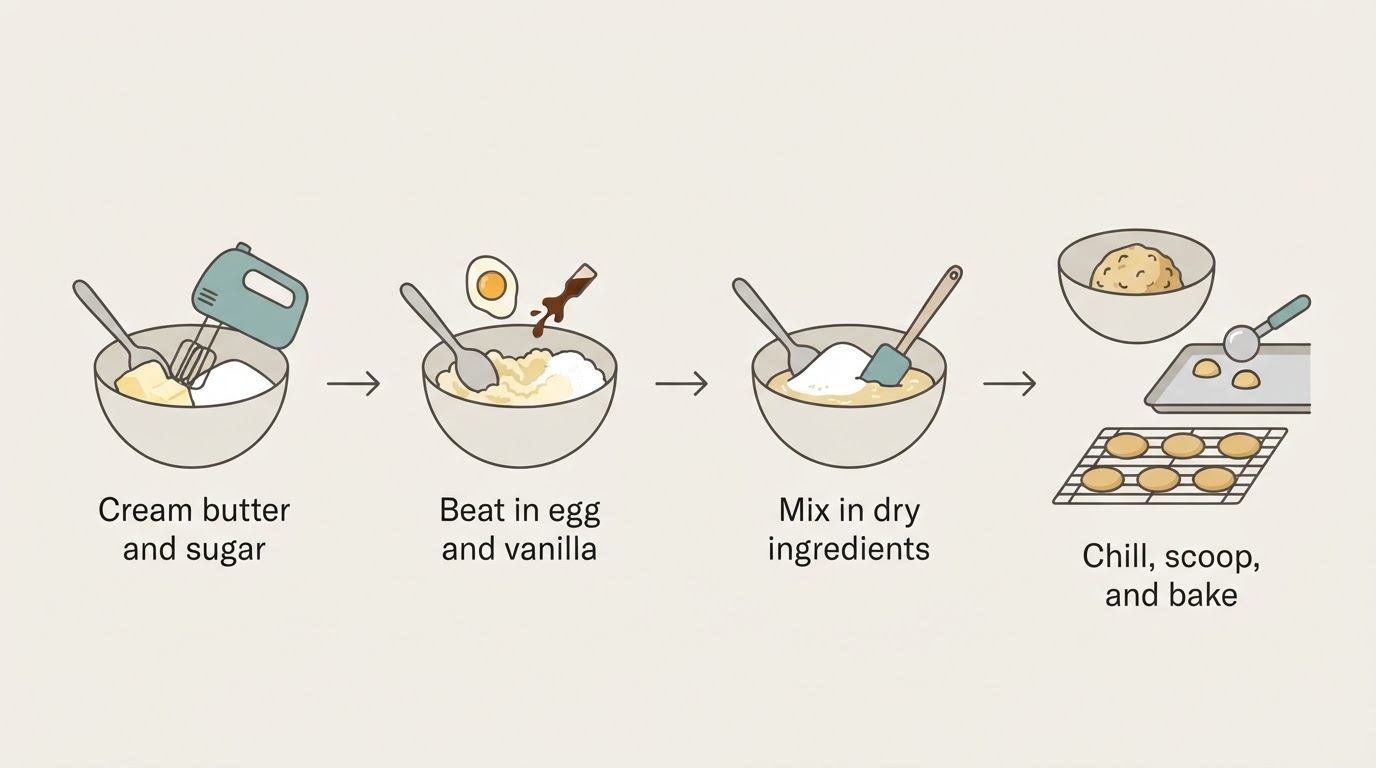
The method runs in a straight line: cream the butter and sugar, beat in the egg and vanilla, mix in the dry ingredients, chill the dough, scoop, and bake.
- Preheat and set up. Heat the oven to 350°F (175°C) with a rack in the middle, and line your baking sheets with parchment. If you are baking several batches, let each sheet cool before it goes back in the oven, because dough spreads fast on a warm pan.
- Cream the butter and sugar. Beat 1 cup softened butter with 1 cup granulated sugar on medium speed for 2 to 3 minutes, scraping the bowl once. You are done when the mixture looks pale and fluffy and no longer feels gritty when you rub a little between your fingers.
- Add the egg and vanilla. Beat in 1 large egg and 2 teaspoons vanilla until the mixture looks smooth, about 30 seconds, then scrape the bowl. It may look slightly separated for a moment. Keep going, and it comes back together.
- Whisk the dry ingredients. In a second bowl, whisk 2¾ cups all-purpose flour with 1 teaspoon baking powder, ½ teaspoon baking soda, and ½ teaspoon fine salt. Whisking does the job of sifting and takes less time.
- Combine, but not too much. Add the dry mixture to the butter mixture in two additions on low speed, and stop as soon as the last streaks of flour disappear. The dough should be soft, slightly tacky, and pulling away from the bowl in one mass. Every extra turn of the mixer develops gluten, and gluten is what makes a cookie tough instead of tender.
- Chill for 30 minutes. Cover the bowl and put it in the refrigerator. Chilling firms the butter and gives the flour time to absorb liquid, which is the simplest way to keep the cookies from spreading into lace.
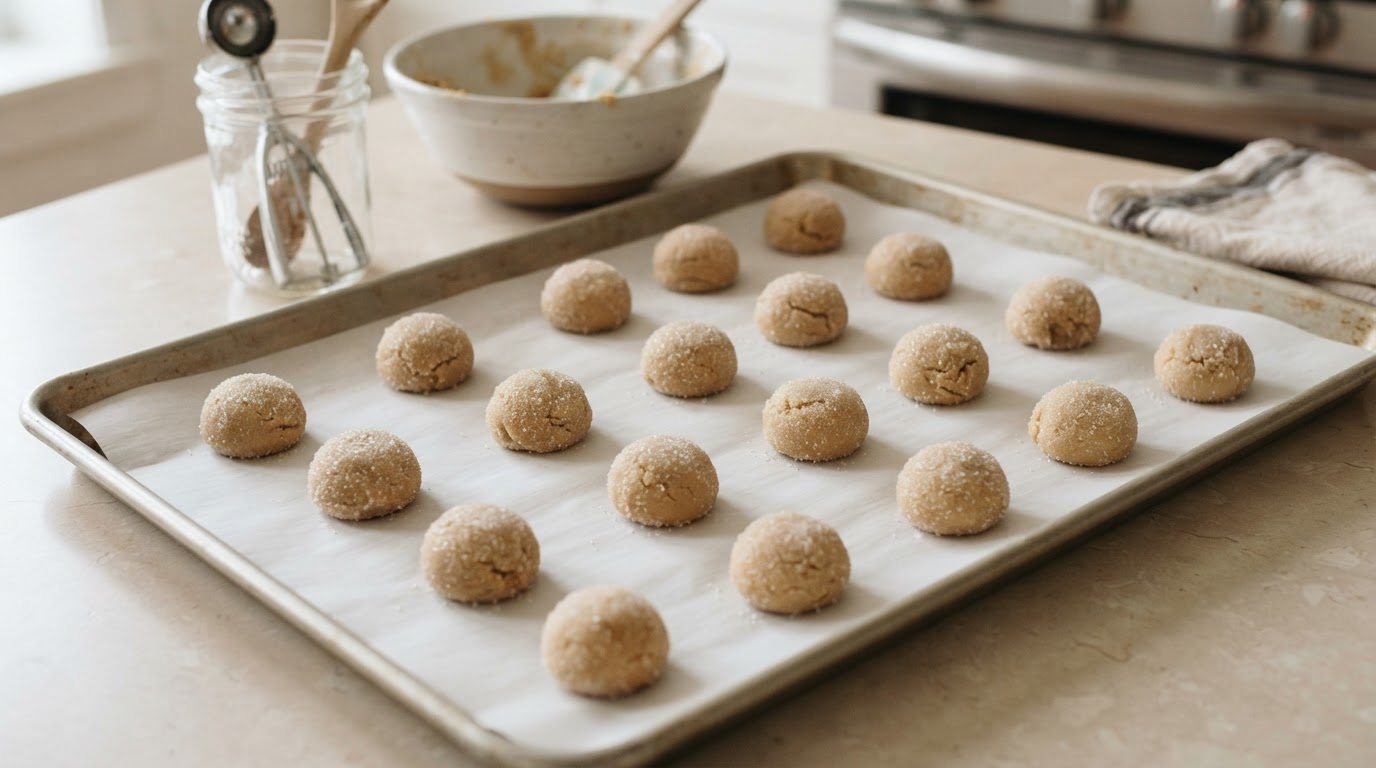
- Scoop and roll. Portion the dough into 1½-tablespoon mounds, roll each one into a ball, and roll the ball in sugar. Set the balls 2 inches apart on the lined sheets. If the dough starts to feel greasy while you work, put it back in the refrigerator for 10 minutes.
- Bake 9 to 11 minutes. Pull the sheets when the edges are set and barely golden and the centers still look a touch underdone. They finish setting on the pan.
How to Tell When Drop Sugar Cookies Are Done
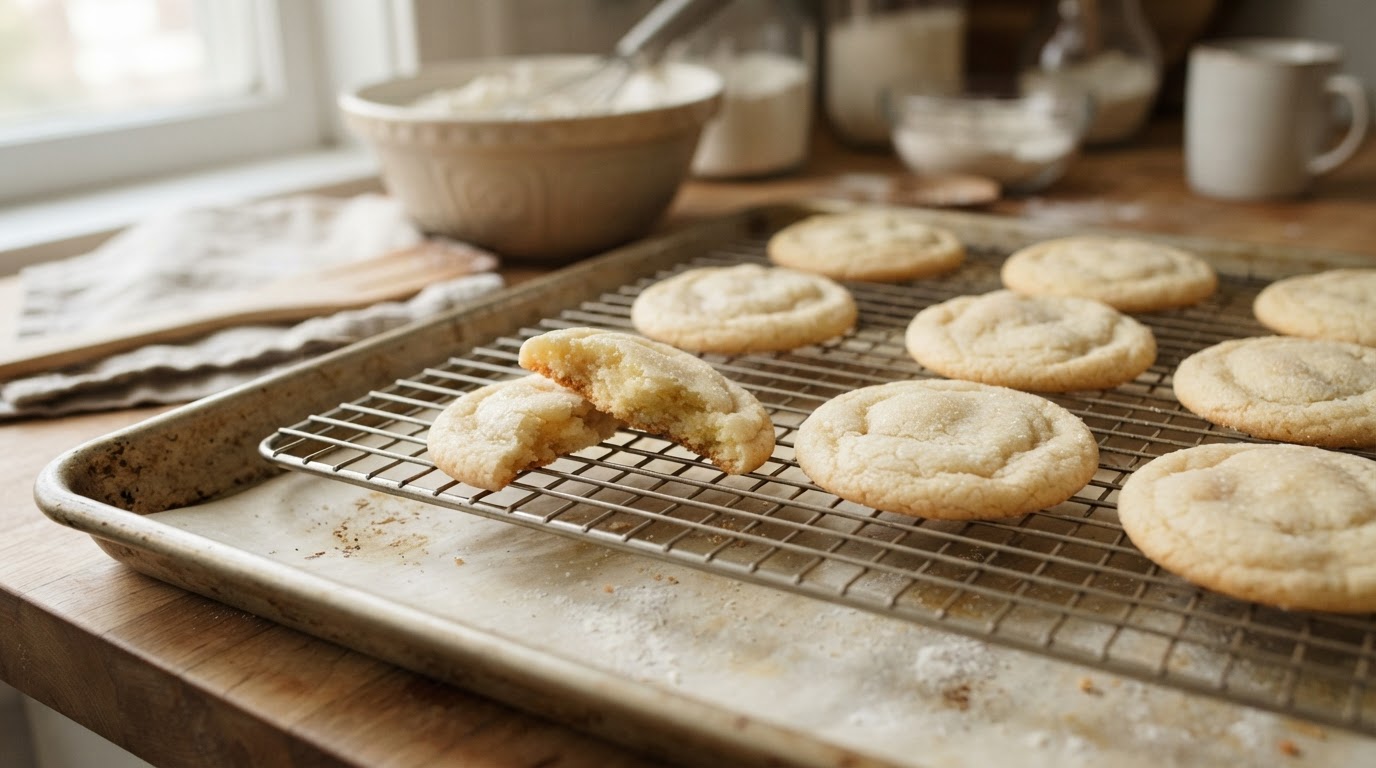
The edges are your signal and the center is your test. A finished drop sugar cookie has:
- a set rim that is just beginning to color, never dark brown;
- a puffed middle that has lost its raw shine but still gives slightly under a fingertip;
- fine cracks across the top where the sugar crust has split;
- enough structure to slide when you nudge one with a thin spatula.
Baking one test cookie first lets you read your oven before committing a whole tray. Pull at 9 minutes for a softer, bendier cookie, or go to 11 or 12 for a crisper one, and accept that the soft middle shrinks as the bake lengthens. That trade-off is the whole game with drop cookies, because you are choosing where on the soft-to-crisp line you want to land.
Either way, cool the cookies on the sheet for 5 minutes before moving them to a rack. That time is not optional. The residual heat finishes the middle without drying out the edge.
Troubleshooting Drop Sugar Cookies
Problem | What usually caused it | The fix |
|---|---|---|
Spread into thin, lacy disks | Butter was too warm, the dough went in warm, or the pan was still hot | Soften butter only to cool room temperature, chill the dough 30 minutes, and cool sheets between batches |
Stayed domed and barely spread | Butter was too cold or under-creamed | Let the butter soften fully and cream for the full 2 to 3 minutes |
Dry, crumbly, sandy texture | Too much flour, or a minute too long in the oven | Weigh the flour or spoon and level it, and pull the next batch earlier |
Cakey and bread-like | The dough was overmixed after the flour went in | Mix on low and stop at the first sign of no dry streaks |
Pale tops, dark bottoms | The rack sat too low, or a dark pan ran hot | Move the rack to the middle and switch to light-colored sheets |
Raw centers, burnt edges | The oven ran hot, or the mounds were too tall | Check the oven with a thermometer, drop the heat 25°F, and flatten the balls slightly |
Sticking to the pan | No parchment, or the cookies were moved while still hot | Line the sheets and wait the full 5 minutes before lifting |
Most of these problems come back to two variables: butter temperature and flour amount. Get those right, and this drop sugar cookie recipe is one of the most forgiving around.
Variations Worth Trying
Once the plain version works, the formula takes small changes well.
- Cinnamon sugar instead of plain sugar. Roll the dough balls in ¼ cup sugar mixed with 1 teaspoon cinnamon for a snickerdoodle-adjacent finish.
- Brown sugar for chew. Swap half the granulated sugar for light brown sugar. The cookies pick up moisture and a deeper flavor, and they brown a little faster, so watch the first batch.
- Almond or citrus. A quarter teaspoon of almond extract, or a tablespoon of orange or lemon zest, changes the character of the batch without changing the method.
- Mix-ins. Mini chocolate chips, chopped white chocolate, or sprinkles folded in at the end all work as long as you keep the total to about a cup.
- Coarse sugar on top. Turbinado or sanding sugar gives the crackled top more crunch than granulated.
If you want more from-scratch cookie recipes to work through, The Rustic Bakehouse keeps a cookie collection built the same way: short ingredient lists, an upfront yield, and bake times you can plan around.

Felo product screenshot.
Make Ahead, Store, and Freeze
The dough from this drop sugar cookie recipe is made for planning ahead. Portion and roll the dough balls, freeze them on a sheet until solid, then bag them. They bake straight from frozen with an extra minute or two in the oven, so a weeknight batch needs no mixing at all.
Baked cookies keep in an airtight container at room temperature for about 3 to 5 days. Keep them out of the refrigerator, because cold air dries them out faster than room temperature does. For longer storage, freeze baked cookies between sheets of parchment for up to 2 to 3 months and thaw them at room temperature, still wrapped, so they do not collect condensation.