What the Smell Can and Cannot Tell You
A cheese-like aroma is an imprecise description, not a diagnosis. King Arthur Baking describes a usual starter aroma as clean and sour and accepts alcohol notes (Sourdough Baking FAQ). Its beginner tips distinguish a temporary stinky phase in a young starter from an established starter developing an awful smell (10 tips for new sourdough bakers). Neither source makes every cheese-like odor safe.
That line is why smell alone cannot identify a microorganism or establish safety. A note that reads like parmesan, blue cheese, or something similarly sharp can turn up in a jar that is still settling into a rhythm, or in one that has gone longer than usual between feedings. The useful question is not whether the smell is exactly right, but whether the jar shows any of the signs that mean stop.
What a normal starter smells like
What should sourdough starter smell like when it is thriving? Compare it with the clean-sour baseline above, but do not try to certify safety from an odor description. Record what changed, when you last fed the jar, and whether it is a new culture or a previously reliable one. That context is more useful than choosing a particular cheese name.
Is This a New Starter or a Changed One?
Treat these as two different situations.
A newly developing starter. A strong smell can occur during development. Check for contamination first; the jar's age does not override warning signs. If none are present and the smell is not foul or alarming, continue your established starter recipe and observe. When uncertain about contamination, discard and start again.
A mature starter whose smell suddenly changed. This is the case that deserves the closest look, because an established starter should never smell awful. If your usual clean aroma has turned alarming, stop and examine the jar before feeding it again.
A neglected starter that smells only a little off. If a refrigerated jar has gone longer than usual between feedings, King Arthur notes that a few days of room-temperature feedings will likely restore its usual pleasant aroma.
The Keep-or-Discard Check
What you notice | What it usually means | Next step |
|---|---|---|
Cheesy smell, bubbles, young jar | A developing culture is possible; bubbles do not prove safety | Inspect for warning signs first; continue the recipe only if there are none and the odor is not foul |
Changed smell after a long gap between feeds | Feeding history may matter, but cheese smell alone does not diagnose hunger | Inspect the whole jar; do not use feeding to rescue suspected contamination |
Sharp vinegar or alcohol-like notes | Acid and alcohol build up after a late feed | Feed and recheck; if the odor turns foul rather than sharp, treat it as a stop sign |
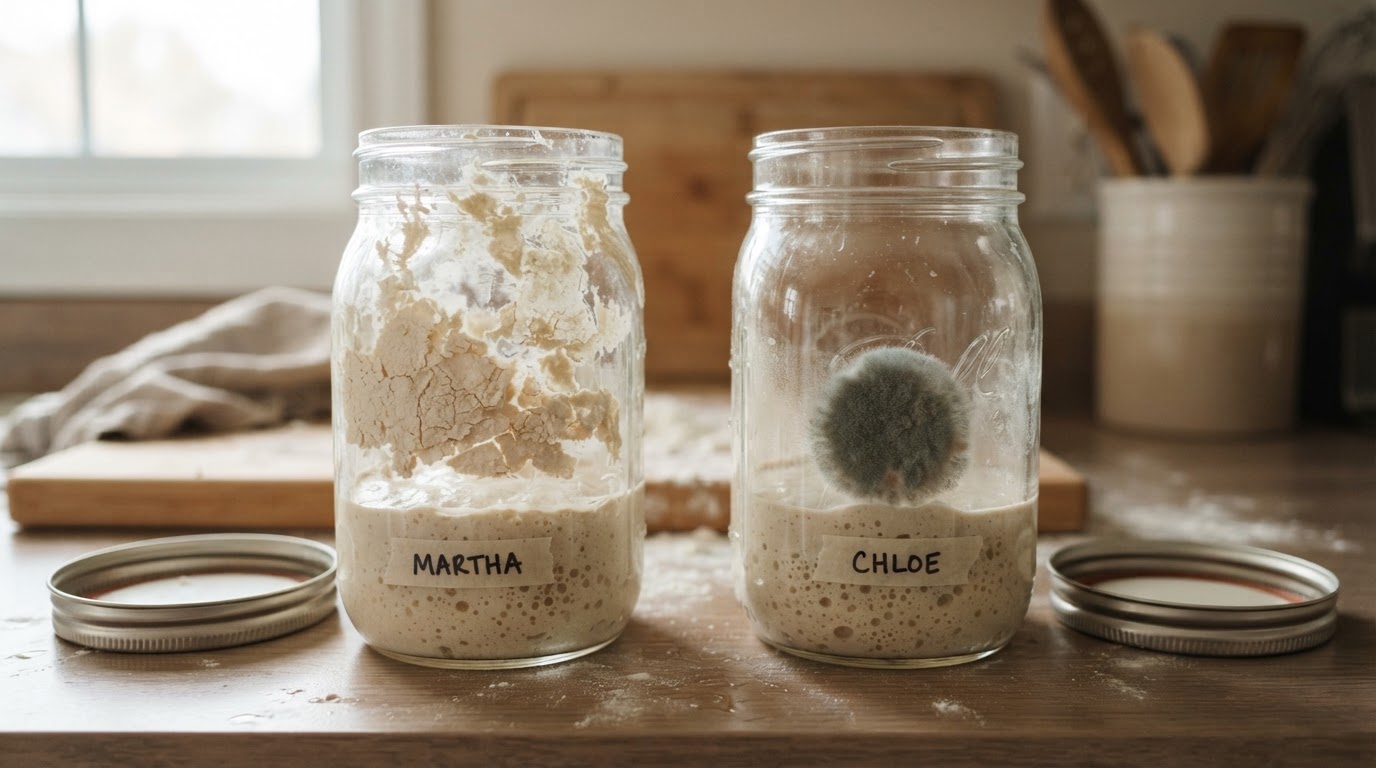
Fuzzy mold or colored fuzz | Contamination | Discard the whole jar; do not scoop around it |
Pink or orange streaks | Contamination | Discard the whole jar and start fresh |
Clearly putrid, rotten, or otherwise alarming odor | Spoilage | Discard; do not bake with it and do not taste it |
The discard rows follow King Arthur Baking's published rule: mold, an odor that is not the usual clean, sour aroma, or a pink or orange color means throw it out (Sourdough Baking FAQ). The feeding rows are conservative troubleshooting suggestions, not a safety test. Feeding cannot make mold or pink or orange color safe.
Conservative Stop Conditions
Stop and discard the jar, rather than trying to rescue it, when you see:
- visible mold, including fuzzy or colored growth;
- pink or orange discoloration;
- a clearly putrid or unusual odor in a starter that had been established.
Do not scrape mold off the surface, and do not bake with a contaminated starter to use it up. Never taste raw starter or raw discard to check it: raw flour is not meant to be eaten, and a young or spoiled culture can carry organisms that make you ill (Sourdough Starter Bubbling but Not Rising).
If Something Else Looks Wrong Too
A smell is only one reading. If your starter is bubbling but not rising, the full walkthrough is in our guide to sourdough starter bubbling but not rising. If the jar is thin and pourable, that is a hydration and feeding-ratio issue; the separate guide on how to fix a watery sourdough starter covers it.
A Short Practical Checklist

Illustration, not a photo of a tested starter. Appearance alone cannot establish food safety.
- Note whether the jar is new or established, and whether its smell changed.
- Check the surface and the color before feeding: fuzzy growth, colored fuzz, or pink or orange streaks mean discard.
- Smell from a short distance; do not taste.
- If no warning signs are present and the odor is not foul or alarming, follow your existing starter recipe and record changes; do not assume cheese smell means hunger.
- Recheck the smell after several feedings, not after one.
- Stop and throw the jar out if the odor turns clearly putrid, or if you are unsure it is safe.
- Never use discard from a suspect or immature starter as a way to avoid throwing it away.
FAQ
Can I bake with a starter that smells like cheese?
If the jar is young or only mildly off, the safer move is to feed it back to a normal clean-sour smell before baking, and wait for a reliable rise. If you see mold, pink or orange color, or a putrid odor, do not bake with it at all.
My starter smells like blue cheese or parmesan on day 3. Is that normal?
A temporary strong-smelling stage can occur, but neither the day number nor a cheese comparison establishes safety. Inspect the jar before feeding; discard if warning signs are present or contamination is uncertain.
Does a cheese smell mean my starter is hungry?
Not as a rule. Hunger is easier to read from a sharp vinegar note, or an acetone-like smell with dark liquid on top, than from a cheese note alone (how to fix a watery sourdough starter). If the odor is foul rather than sharp, treat it as a stop sign instead of a hunger cue.