The short answer
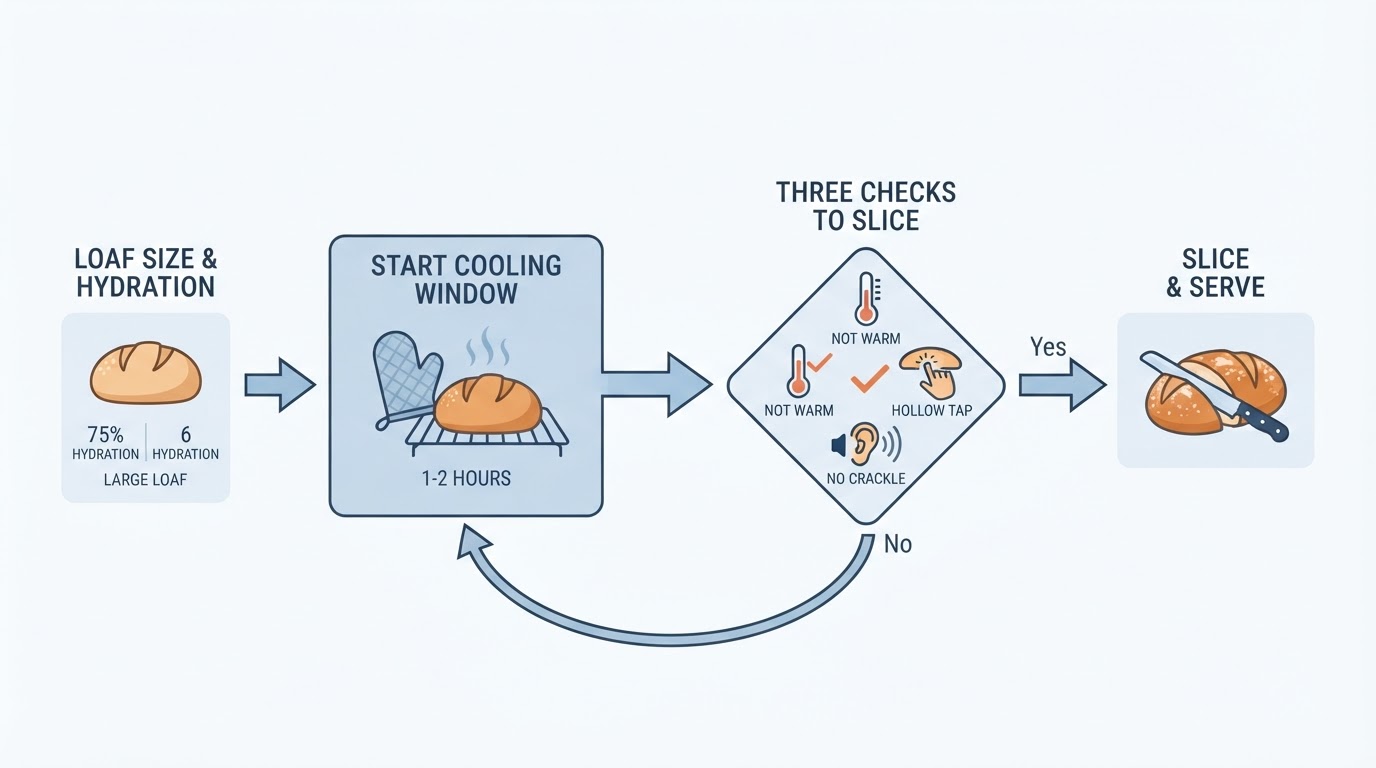
A bread recipe may give a useful starting window: The Perfect Loaf's beginner sourdough cools on a rack for one to two hours before slicing. That is a recipe-specific example, not a clock for every loaf. King Arthur Baking recommends letting sourdough cool completely before slicing for best results.
Treat those numbers as a range to start from, then let the loaf tell you when it is ready.
Why cooling is part of the bake
When bread leaves the oven, it is still finishing inside. The center is close to 200°F, and the starches that gelatinized during baking are still soft and mobile. As the loaf cools, those starches and the protein structure firm up, and the interior steam settles into the crumb more evenly.
Slice too early and three things go wrong:
- The blade compresses crumb that has not set, so it smears instead of cutting cleanly.
- Steam escapes from the cut face instead of the crust, leaving a sticky, gummy surface.
- That moisture loss also makes the exposed crumb dry out and stale faster.
This is a post-bake cooling effect, not necessarily a fermentation problem: a well-fermented loaf cut while its center is still warm can still disappoint.
What changes your cooling window
Four things move the window more than anything else: mass, moisture, crust, and airflow.
- Loaf size. A 1 kg loaf holds far more heat in the middle than a 500 g one. Bigger loaf, longer wait.
- Hydration. Wet doughs carry more water that must redistribute as the loaf cools, so the crumb takes longer to settle.
- Flour and density. Rye and whole-grain loaves hold moisture tightly and set slowly, so they often benefit from a longer rest, even overnight.
- Your kitchen. A warm, steamy kitchen slows cooling; a cool, dry kitchen with moving air speeds it up.
A practical cooling and slicing chart
Loaf | Relative wait | Check before slicing |
|---|---|---|
Small or soft pan loaf | Shorter than a large dense loaf | Center and base no longer feel warm |
Standard boule or bâtard | Use the recipe's rack-cooling time as a starting point | No warmth where the base meets the rack |
Large miche or high-hydration loaf | Allow extra time | Center has cooled through, not only the crust |
Rye-heavy or dense mixed-flour loaf | Follow the specific recipe; some call for an extended rest | Slice only after the recipe's resting step |
Use the check column, not the clock, for the final call.
How to cool a loaf so the crumb sets
- Get the loaf out of the pan or Dutch oven and onto a wire rack right away. Steam trapped under the bread softens the bottom crust and slows cooling.
- Leave space around the loaf. Air needs to move across the sides and under the base; a crowded counter is a steamer, not a cooling rack.
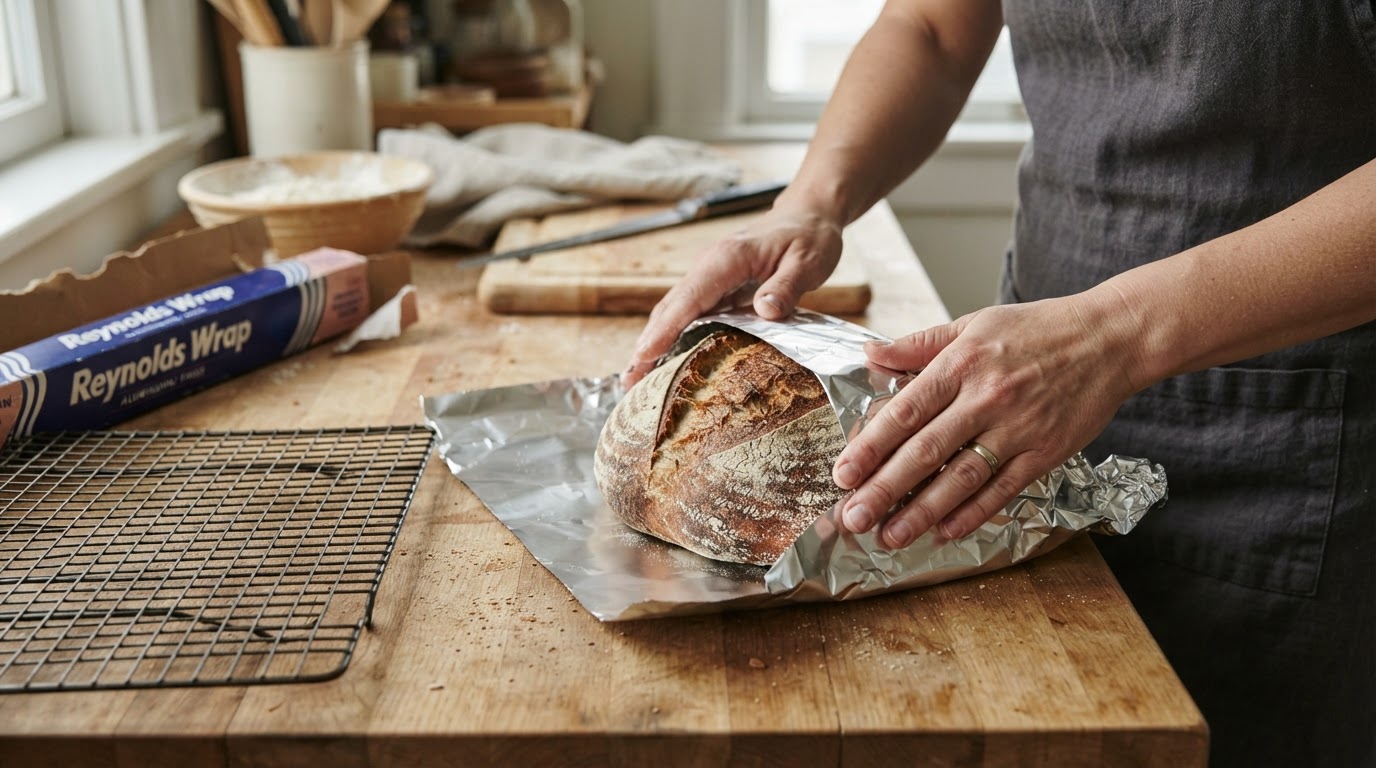
- Do not wrap, bag, or cover it while it is warm. Wrapping traps the steam you are trying to release, which softens the crust and keeps the interior gummy.
- Use a rack rather than the refrigerator as your default cooling method. The rack lets air circulate around the crust; refrigeration is not a substitute for the recipe's post-bake rest.
- To cool sourdough bread faster, add airflow instead of cold. A fan moving room-temperature air across the rack helps a little; a sealed container does the opposite.
- Wait until the loaf is cool through:
- The underside and sides no longer feel warm.
- The center is not still releasing visible steam when an end is cut.
- The recipe's stated resting instruction has been met.
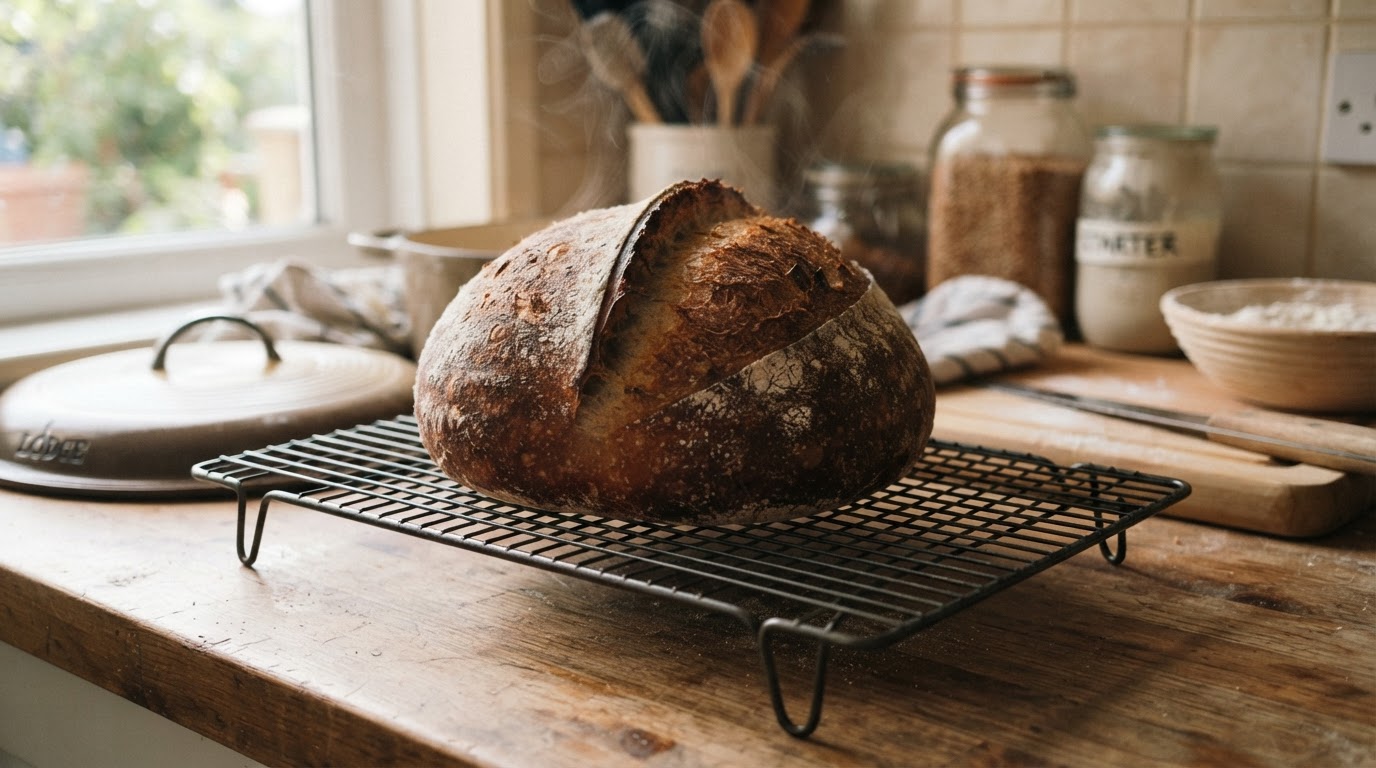
When the loaf has cooled through, it is ready to slice. Let it cool completely before airtight storage or freezing.
Safe handling and best eating texture are two different questions
Let the loaf cool completely before sealing it in a bag so condensation does not collect inside. For storage beyond a day, King Arthur Baking recommends an airtight bag or freezing; it notes that paper allows a crusty loaf to stale more quickly than airtight storage.
Best eating texture is a separate choice. Some bakers cut a slightly warm loaf because they prefer it that way; waiting until it is fully cool generally gives cleaner slices and a more stable crumb. Cutting while the center still releases a lot of steam is likelier to compress the crumb.
Where cooling advice usually goes wrong
- One fixed time for every loaf. Size, hydration, and your kitchen change the answer.
- Trusting the crust temperature. A loaf can feel cool outside while the center is still warm.
- Using the fridge as a shortcut. Start with the recipe's rack-cooling instruction rather than treating a chilled crust as proof that the center has set.
FAQs
Can I slice sourdough after one hour?
Sometimes: The Perfect Loaf's cited beginner recipe gives a one-to-two-hour rack rest, but a different loaf may still be warm inside after one hour. If it smears under the knife, stop and let the remainder cool before judging its final crumb.
Can I let sourdough cool overnight?
Yes, if your kitchen and recipe make an overnight rest practical. Let the loaf cool fully on a rack first. For next-day storage, choose the wrapping method that suits your crust preference; do not seal a warm loaf in a bag.
Why is my sourdough still gummy after three hours?
If the loaf has fully cooled and still feels sticky, cooling time alone may not explain it. Compare the bake and fermentation with your recipe, and use our sourdough crumb guide to distinguish a dense crumb from one merely compressed by early slicing. The Perfect Loaf's beginner recipe, for example, checks the baked center before the rack rest; that target is specific to the recipe.