What to use instead of rice flour
The short answer: semolina, a whole-grain flour with the bran still in it, or all-purpose or bread flour in a light, even coat. Any of them can work, and any flour beats a bare, sticky basket. What matters is how much of the dusting stays on the surface as a dry barrier and how much of it soaks into the dough and becomes part of the crust.
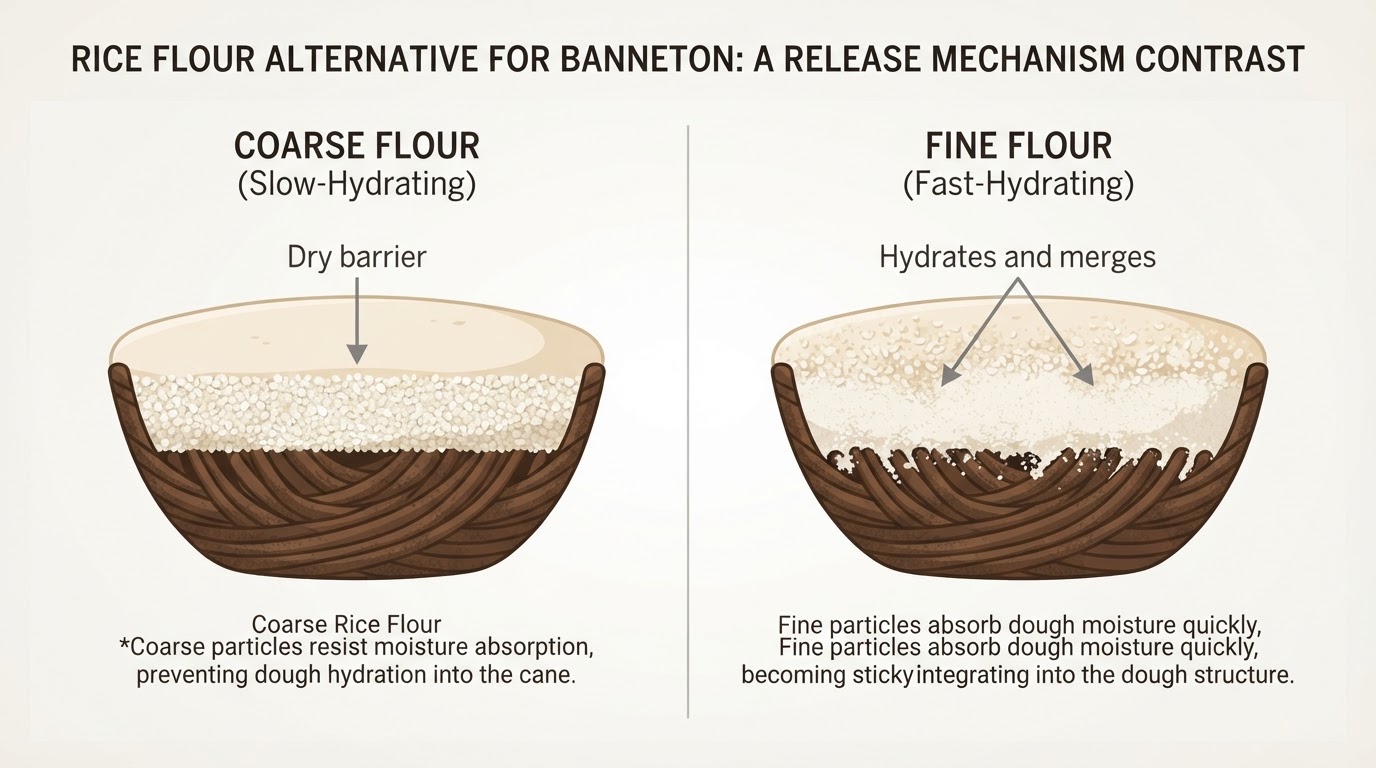
Rice flour is the usual first choice because it stays on the surface instead of merging into the dough. Other flours can behave the same way when they are coarse or slow to absorb water. King Arthur Baking's guide to bannetons and brotforms makes the point plainly: many bakers pick a coarse flour such as semolina or rice flour because it creates a more noticeable barrier and does not incorporate into the dough itself, while whole-grain flours with bran release dough better than white flour (King Arthur Baking).
Rice flour alternatives, compared
Dusting choice | How it behaves in the basket | Best suited to |
|---|---|---|
Semolina | Coarse grains sit between the dough and the cane as a physical barrier, and leave a lightly speckled surface | Wet, high-hydration doughs and long cold proofs |
Whole-wheat or whole-grain flour with bran | Bran particles help the loaf release and add color and a little flavor | Everyday country loaves and hearty rye-forward doughs |
All-purpose or bread flour | Fine and quick to hydrate, so it can merge with the dough and grip the weave | Drier, lower-hydration doughs and short proofs, applied in a heavier even coat |
Banneton cloth or linen liner, lightly dusted | The fabric adds a barrier that also catches surface moisture, and the loaf comes out smooth instead of ringed | Very wet or enriched doughs, and any proof you would rather not babysit |
A blend of a coarse flour with your everyday flour | The coarse half does the releasing while the finer half supplies flavor or color | When you want clean release plus the character of a specific flour |
Whichever row matches your bake, aim for a thin, even coat, not a snowfall.
How to dust a banneton without rice flour
- Start dry. The basket, and the liner if you use one, must be completely dry. Damp fibers make flour clump and stick.
- Choose your surface. If you use a liner, fit it now and plan to dust the fabric; if you go bare, you will dust the cane itself.
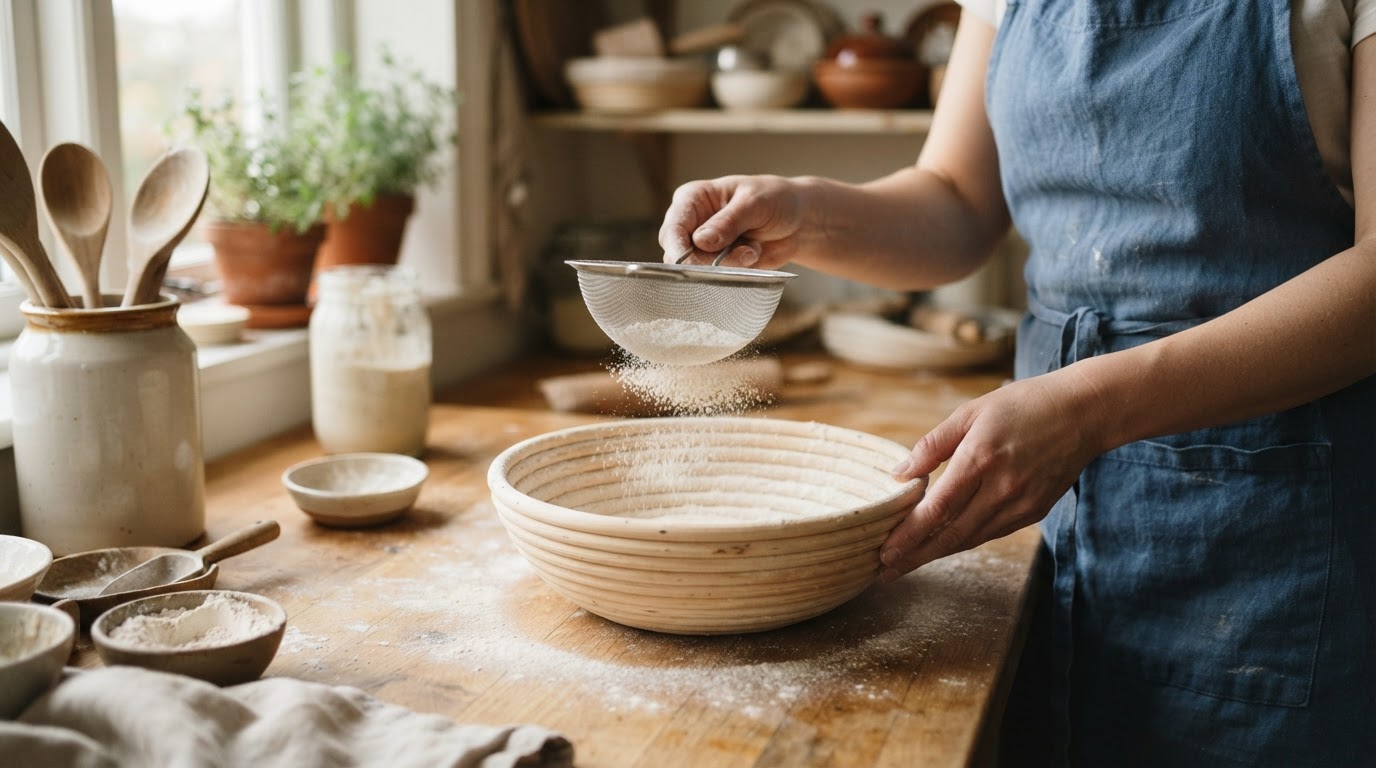
- Load a sieve or shaker. A fine sieve, sifter, or shaker gives you a far more even coat than tossing flour from your hand.
- Dust lightly but thoroughly. Coat the coils, the sides, and the base, then tap the basket and shake the excess out over the sink or a sheet of parchment.
- Check the finish before the dough goes in. The surface should look evenly frosted, with flour settled into the grooves, no bare patches, and no caked piles. If you can still see cane or liner through the coat, add a little more and shake again.
- Load and proof. Place the shaped dough seam side up, cover the basket, and proof according to your recipe.
- Invert with confidence. Turn the basket out in one motion. A dry, matte dough surface and a clean release are the signs that the dusting did its job.
Is a cloth liner better than dusting flour?
Not better or worse, just different. The same King Arthur Baking guide notes that a basket works with or without a liner, and that a liner can help prevent sticking and make release easier, a sensible pick for very wet doughs. The trade-off is the finish: a lined banneton gives you a smooth crust instead of the spiral or ring pattern, and the cloth needs its own light dusting of flour. The liner also has to dry fully between bakes, just like the cane.
If the dough still sticks, look past the flour
Sticking is usually a dough problem wearing a flour problem's clothes. Slack, high-hydration doughs grip the basket more readily, and how you handle them matters. King Arthur Baking's tips for high-hydration doughs recommend gentle shaping: too much pressure compresses and tears the dough, and a torn surface exposes a sticky interior that grabs everything it touches. Over-proofed or over-warm dough also loses structure and turns gluey, and a basket that is still new has not yet built up the thin flour lining that seasoned bannetons rely on. A cold retard helps here: a night in the fridge firms the shaped loaf and dries the surface, which makes the dough easier to release and easier to score (King Arthur Baking).
What a different dusting flour cannot fix
No flour choice guarantees a clean release. Humid kitchens, damp flour, an under-seasoned basket, and a dough that was already over-proofed can all defeat a good dusting. More flour is not always better either: a thick, caked coat transfers to the crust and leaves a raw, floury taste, so keep the layer thin and even. And do not clean your way into trouble: cane and wood bannetons should be brushed dry, not washed with soap and water, and the flour that builds up over repeated bakes is what helps future loaves release. Treat dusting as one part of a chain that also includes shaping, fermentation, and proofing, not as a single fix.
FAQs
Can I use all-purpose flour instead of rice flour in a banneton?
Yes, and for drier doughs it often works fine. All-purpose and bread flour are finer and hydrate faster than coarse alternatives, so they can merge with the dough surface and grip the weave. Apply a slightly heavier, even coat, keep the proof on the shorter side, and use a liner if the dough is wet.
Is semolina a good substitute for rice flour in a banneton?
It is one of the best. Semolina is coarse and slow to absorb water, so it stays on the surface as a barrier, and it leaves a pleasant speckled texture on the crust. Shake off the excess so the grains do not end up in a thick layer on the loaf.
Do I still need to flour a banneton if it has a linen liner?
Yes. A liner helps prevent sticking and makes release easier, but it is not self-releasing. Dust the fabric lightly and evenly before every bake, the same way you would dust bare cane.
If you are still at the beginning of the sourdough process, this site's sourdough starter guide covers the separate fermentation step before a shaped loaf reaches a banneton.