The short answer
A sourdough crust is supposed to be firm. That firmness is what gives a lean loaf its crackle and its keeping quality. The trouble starts when the crust is hard enough that the knife skids, the slice compresses, or you need two hands and a saw. Then the cause is almost always one of four things: a thick crust that set hard in the oven, a crust that kept drying after baking, a loaf sliced before it cooled, or a knife that tears instead of cuts.
The four reasons a sourdough crust fights the knife
A fresh, thick crust that set hard in the oven
Crust forms as the surface of the dough dries and browns, and steam slows that process: while the surface stays moist, the loaf keeps expanding, and the crust that finally sets is thinner. Bake a lean dough hot and uncovered with little steam and the surface sets early, then keeps drying for the rest of the bake. The result is a thick, hard shell over a well-risen, moist crumb.
That is not automatically a flaw. Long-baked country loaves are often designed to have a substantial crust. If the crumb is moist, the flavor is good, and the crust is hard from the moment the loaf cools rather than getting harder day by day, the bake is doing what the recipe intended.
A crust that hardened after baking as the loaf lost moisture
A freshly baked loaf is still changing. Moisture moves between crumb, crust and surrounding air, so a crust may initially soften after cooling but can later become dry and tough in open-air storage. The crumb can also firm as starch retrogrades. These are related but not identical processes: do not assume a hard next-day crust proves the original bake was too dry.
Storage decides how fast this happens. Open air and loose paper pull moisture out of the crust, while a sealed bag traps it, softening a crisp crust but changing the crumb. Cold makes staling worse: bread stales fastest just above freezing, and a refrigerator speeds staling up rather than slowing it down. If the crust has become too hard to cut, cool the loaf completely, keep it in a breathable bag or a bread box, and freeze whatever you will not finish within a day or two.
A loaf that was sliced before it cooled
Cutting into a warm loaf is the most common reason a slice comes out ragged. The starch inside is still soft and the crumb is still full of steam, so the knife drags and compresses instead of slicing and you get a gummy, torn slice. The open faces then let moisture escape, so the rest of the loaf dries out faster too.
The cure costs only patience. Leave the loaf on a wire rack, uncovered, until it is completely cool, bottom included; a large sourdough loaf can take a few hours. If you want to eat it warm, cut from one end, then press the cut face back into place so the rest of the loaf keeps its moisture.
The knife and the way you cut
Even a good loaf cuts badly with the wrong blade. A thin, stiff knife has to be forced through a hard crust, and that force is what crushes the slice. A long serrated bread knife works the other way: the teeth cut the crust, and the blade needs very little downward pressure. A long serrated blade cuts with the least pressure, which matters when the crust is hard.
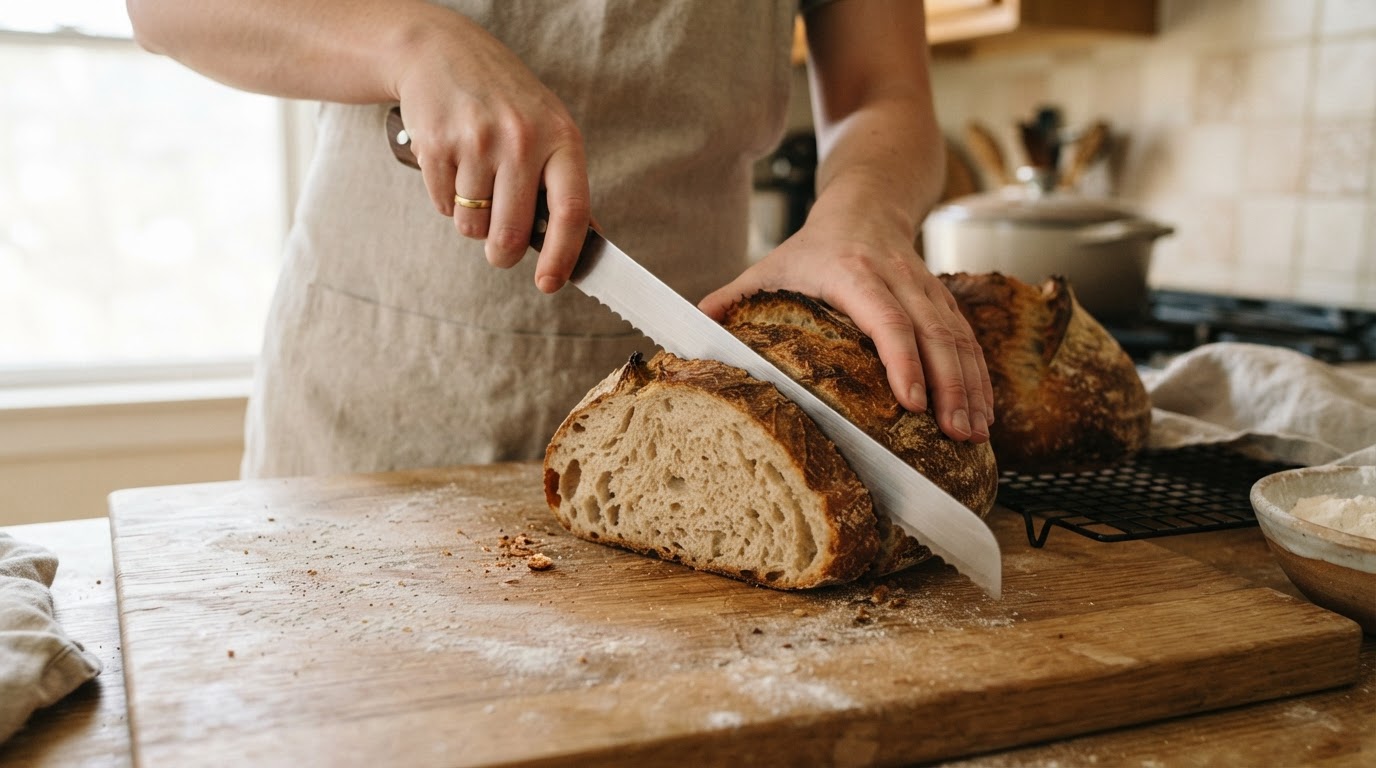
Technique matters as much as the tool. Put the loaf on a board, not in your hand, and let the length of the blade do the work with a light sawing motion instead of pressing the loaf flat. Start a very hard bottom crust from a corner rather than the middle. If the same loaf slices cleanly with a sharp serrated knife and tears with everything else, the crust was never the whole problem.
Match the symptom to the cause
The table below matches what you notice to the most likely cause and the first adjustment to try.
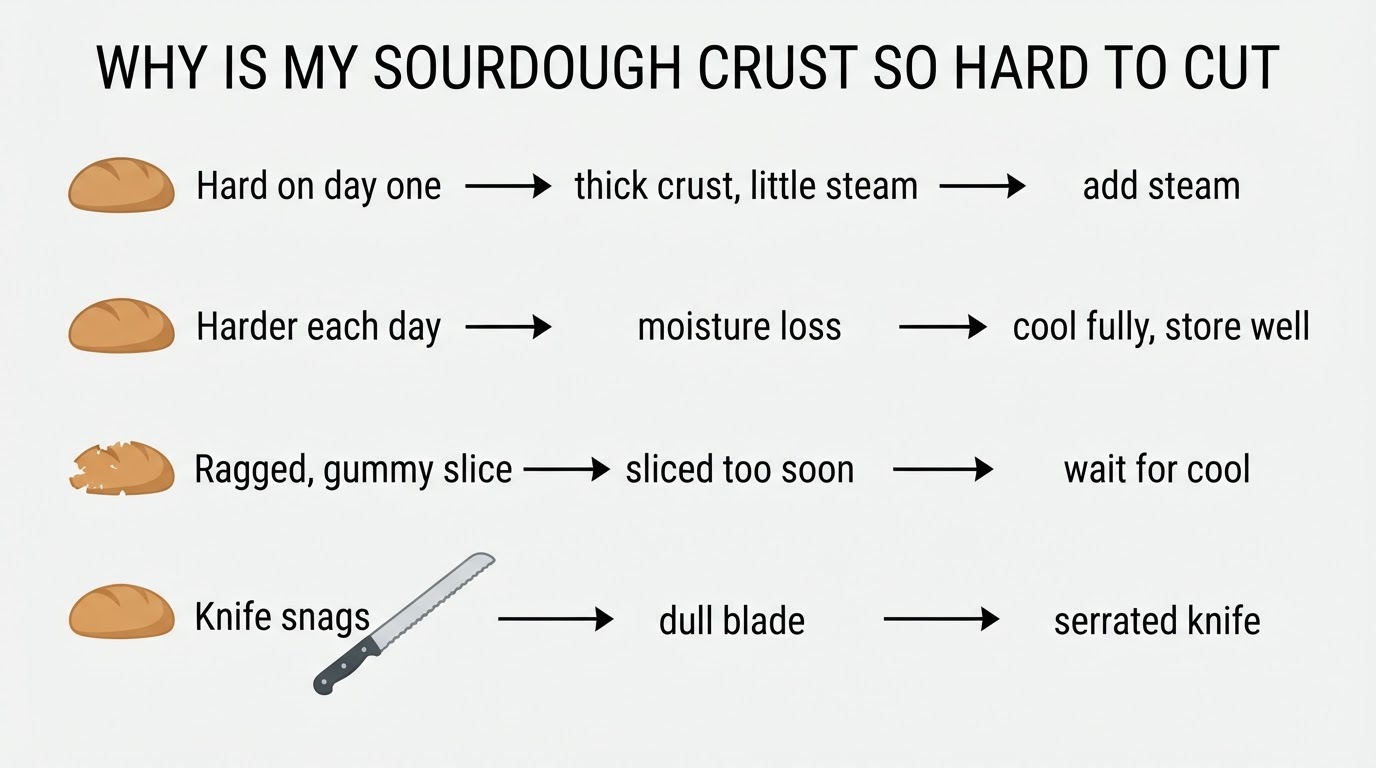
What you notice | Most likely cause | First adjustment to try |
|---|---|---|
Crust is hard on day one, all over, and the crumb is moist | A thick crust from a long, dry bake with little steam | Add steam early in the bake, or shorten the uncovered phase |
Slices fine on day one, then the crust gets harder every day | Moisture loss and staling after baking | Cool fully, store in a breathable bag or bread box, and freeze what you will not finish soon |
Crust is hard and the crumb is dry or pale | Baked past the point the dough needed, or a low-hydration dough | Pull the loaf at the recipe's doneness cues; look at hydration next bake if the crumb stays dry |
The bottom is much harder and darker than the top | Too much heat from the stone or the base of the Dutch oven | Slide a baking sheet under the pot or stone for the uncovered part of the bake |
Slices tear, stick, and look gummy even though the loaf is baked | Cut before the loaf finished cooling | Wait until the loaf is completely cool, then slice |
The knife snags, skids, or flattens the loaf | A dull blade, the wrong knife, or too much pressure | Use a long serrated bread knife and let the teeth do the cutting |
Single-variable adjustments: change one thing per bake
Sourdough has many moving parts, and changing several at once is how a baker ends up unable to say what fixed the crust. Pick one lever from the table and keep everything else, flour, hydration, starter, shaping, proof times, scoring, and the rest of the bake, exactly the same.
- Steam. Early steam can delay crust setting and change expansion and thickness. In a Dutch oven, the covered loaf traps some of its own moisture. If you bake openly, follow the steam method and safety instructions in your recipe; do not pour water onto hot glass or an oven component not designed for it.
- Lid timing. Keep the loaf covered longer and uncover it later when the crust sets hard before the loaf has finished expanding.
- Temperature. A hot start drives oven spring, while a long, moderate finish dries the crust. If the crust is the problem, shorten the dry finish before you lower the starting heat.
- Bake time. Judge the end of the bake by the recipe's doneness cues rather than the clock. A few extra minutes past a deep color adds crust, not flavor.
- Bottom heat. A hard bottom crust is usually about the stone or the pot rather than the dough. Move the loaf higher, or slide a sheet pan under the pot.
Write down the one change and what you noticed. That note is what turns the next bake from a guess into a real test.
Completion check: after a single-variable bake, let the loaf cool fully and use the same sharp serrated knife as before. If slices now cut cleanly without crushing the crumb, that change may have helped. If the crust still needs force, go back to the symptom table before adjusting another variable.
How to tell the four causes apart
- A fresh, thick crust is hard from the moment it cools and sounds crackly, but the crumb is moist and springs back.
- A staled crust was easier to cut yesterday and grows harder day by day; the crumb also firms, and the crust sounds dull when tapped.
- An undercooled loaf gives a gummy, ragged slice that sticks to the knife and compresses under your fingers, and it happens right after baking.
- A knife problem shows up as the same loaf cutting cleanly with a sharp serrated blade and badly with anything else.
What you can and cannot fix after baking
You cannot un-bake a loaf, and staling cannot be fully reversed, but a hard crust can be improved for a meal. A light spritz of water followed by a few minutes in a moderate oven softens the surface, and gentle heating also partially reverses staling, which is why bread firms up less when it is warmed to around 140 F (60 C). Toasting individual slices gives the same effect with more contrast between crust and crumb. Wrapping a warm loaf in plastic to soften it traps steam and makes the crust rubbery rather than tender, and refrigerating the loaf hardens it faster.
Two limits are worth remembering. Crust character is partly a choice, because a lean, long-baked country loaf is supposed to be chewy and hard is relative to what you compare it with. And one symptom rarely proves one cause, so read the timing, the crumb, and the cut together rather than judging by the crust alone.
FAQs
Is a hard sourdough crust normal?
To a point, yes. Sourdough is a lean dough baked for a crisp, chewy crust, and some resistance at the knife is part of the style. A crust that is difficult to cut but crackles, smells toasted, and covers a moist, open crumb is usually a bake and style question rather than a fault in the loaf.
Why does my sourdough crust get harder the next day?
Because the loaf keeps losing moisture outward and the starch network keeps changing after baking. Both are part of staling. Cool the loaf completely before storing it, keep it in a breathable bag or a bread box for the first day, and freeze loaves you will not finish quickly. Refresh a hard crust with a light spritz and a few minutes in a warm oven, or toast the slices.
Why is the bottom crust harder than the top?
Because the bottom of the loaf sits against the hottest surface in the oven: the stone, the steel, or the base of the Dutch oven. The bottom bakes longer and browns darker than the top, and that extra heat keeps drying it. Slide a baking sheet under the pot or stone for the uncovered part of the bake, move the loaf to a higher shelf, and check the bottom color when you take the loaf out.
The bottom line
Four causes explain almost every sourdough crust that will not cut: the crust is thick by design, it has dried out since baking, the loaf was sliced too soon, or the knife is working against you. Cool the loaf completely, cut it with a long serrated knife, and if the crust is still a problem, change one bake variable at a time and note what happened.
If you want a softer crust by design rather than changing a crusty boule, compare the site's separate sourdough sandwich bread recipe.