Why a loaf can rise and still taste mild
Rise and sourness are two different jobs. Rise is gas: wild yeast eats flour sugars and gives off carbon dioxide, which the gluten network holds in. Sourness is acid: lactic acid bacteria (LAB) live alongside the yeast and produce organic acids as the dough ferments.
That is why a loaf can look right and taste flat. King Arthur Baking's sourdough FAQ puts it simply: the flavor of your bread depends more on how you prepare the dough than on how sour your starter tastes. A longer rise, up to a point, builds flavor, and the temperature of that rise matters as much as its length.
This is not the same problem as a starter that will not rise. If your starter is sluggish, troubleshoot it first; timing depends on temperature, flour and feeding ratio. Our separate guide covers a sourdough starter that bubbles but does not rise.
The four levers that set sourness
Four stages decide most of what you taste. Each one can push the loaf toward sour or back toward mild.
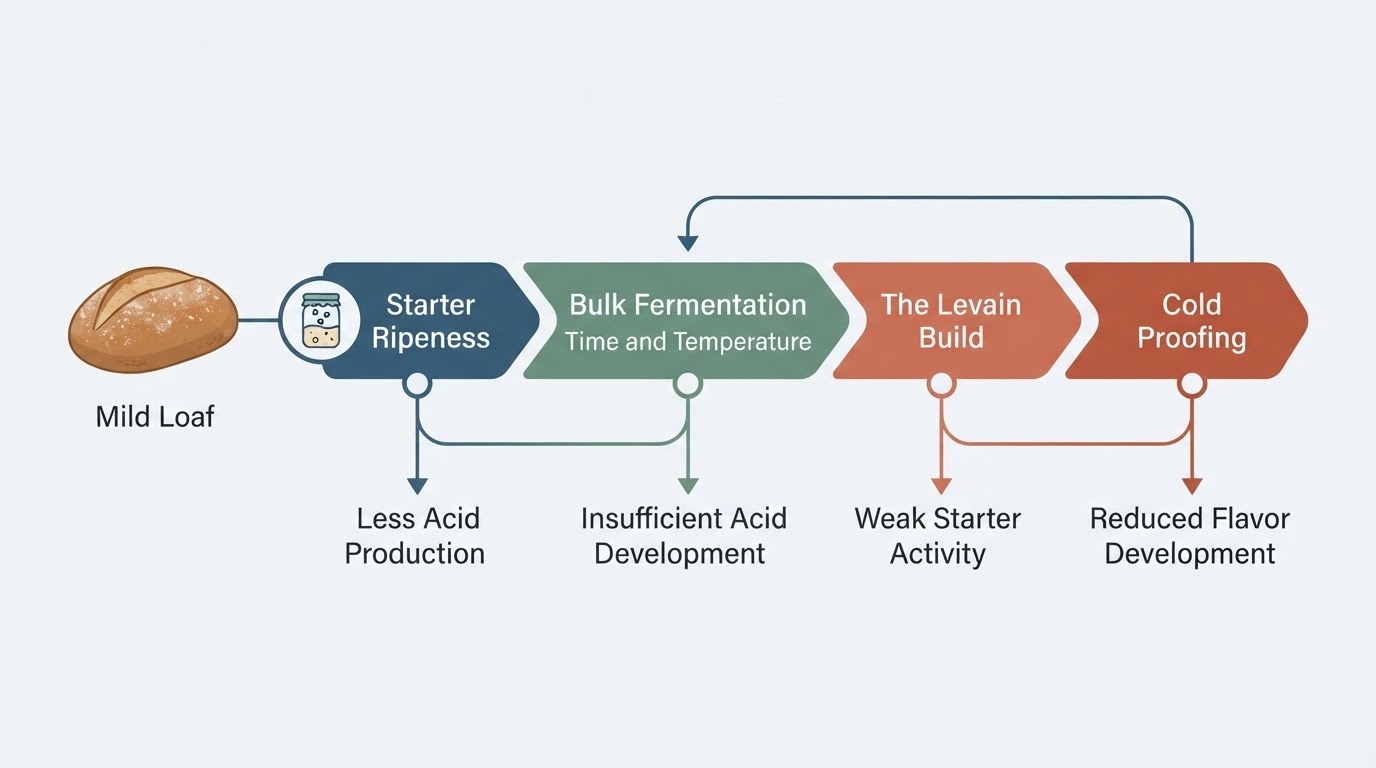
Starter health and ripeness
A healthy starter doubles within six to eight hours of feeding at room temperature, about 68°F–80°F. King Arthur's flavor series calls the routine CARE: consistent feedings, adequate room-temperature feedings, a responsive starter, and a routine easy enough to keep. For a 100% hydration starter, feed twice a day at room temperature, or at least once a week from the refrigerator.
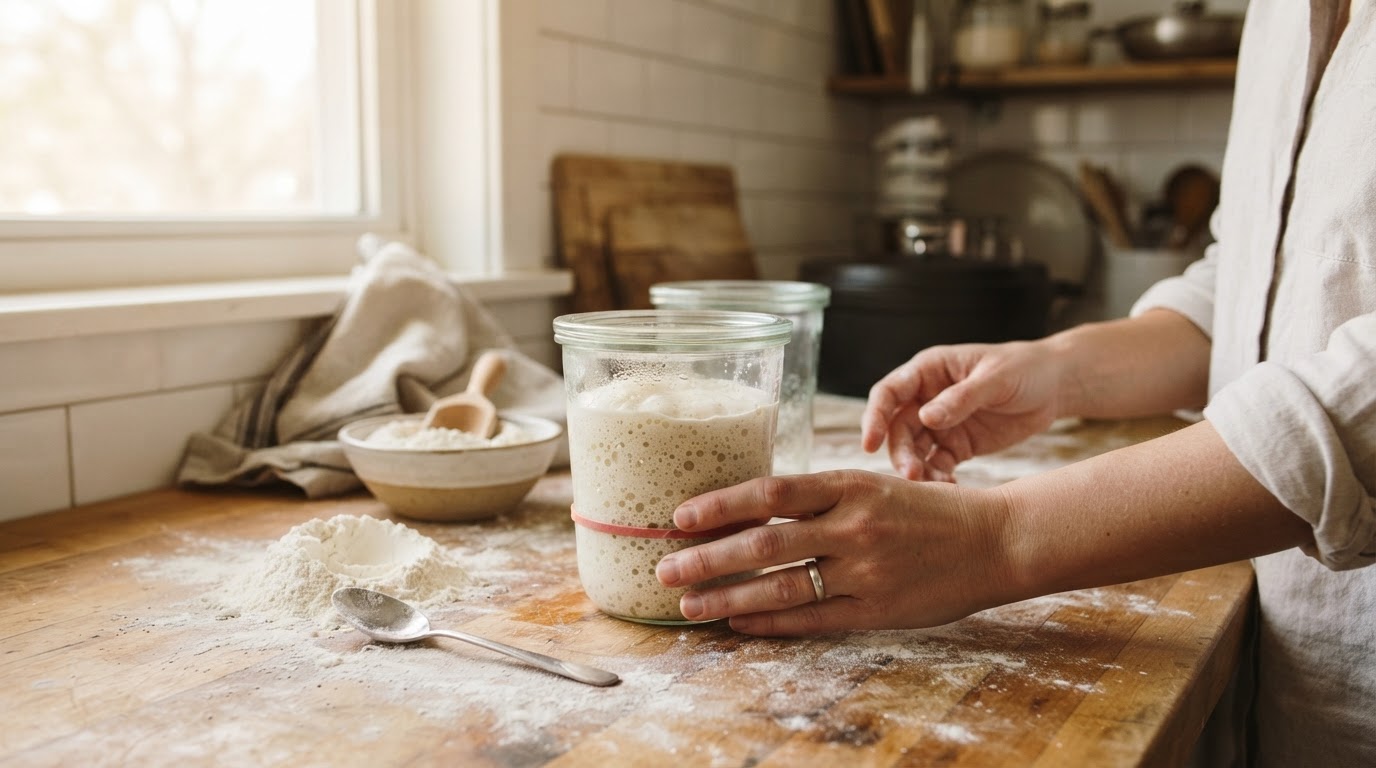
Ripeness is the lever most bakers miss. Looser, warmer, riper starters fed larger meals less often on whole-grain flour favor LAB; stiffer, cooler, less-ripe starters fed smaller meals more often on white flour hold LAB back. Feed near the peak. One caution: a sour starter does not automatically make sour bread, and big changes such as a flour switch can take about ten days to settle.
Bulk fermentation: time, temperature, flour
Once the dough is mixed, the two biggest knobs are time and warmth. Longer fermentation builds flavor, and a warmer dough produces more acid; the ideal temperature after kneading is roughly 75°F–78°F, with water temperature as your main tool. Whole grains, especially whole rye, help twice over: their sugars favor acetic acid, and their minerals buffer the dough so more acid can build. Even about 5% whole rye adds flavor. Salt slows yeast and LAB growth once mixed, so later acids come from metabolism rather than new growth.
The levain (preferment) build
The levain is the bridge between starter and dough: flour and water fermented with ripe starter before the main mix. A stiffer levain gives fewer total acids but a higher proportion of aromatic acetic acid; a looser one builds more total acid. Ripeness at mixing changes the result, too — part 2 of King Arthur's series notes that levain added just past its peak encourages more LAB and a more sour loaf, while levain mixed right at peak stays milder. Larger, less frequent levain feedings also favor LAB.
Cold proofing (retard)
Chilling shaped dough shifts the balance of acids and often adds depth, but it is not a guarantee. King Arthur baked the same dough twice — half the same day, half after 24 hours refrigerated. Most of the time tasters found the refrigerated loaf more sour, yet in one test six of eight picked the unrefrigerated one. Cold can even reduce sourness if the dough never fermented enough at room temperature first, because chilling slows the acid-producing bacteria.
Match what you notice to the lever
What you notice | What it usually means | One change to test |
|---|---|---|
Starter peaks early and smells mild; bread tastes flat | LAB are held back by frequent, less-ripe feedings | Feed nearer the peak and try a larger, less frequent meal, such as 1:4:4 |
Dough felt cool through the bulk and the loaf is mild | Fermentation ran cool | Bring the dough to 75°F–78°F with warmer water |
A long cold proof barely changed the flavor | The dough did not build enough acid before chilling | Ferment longer at room temperature before refrigerating, not longer in the fridge |
The loaf is mild rather than one-note | Total acid is low for your process | Add time or warmth to the bulk, in one increment |
Flavor is flat but not sour | The balance leans toward lactic acid | Try a stiffer levain, or a little whole grain — one change per bake |
Starter is sluggish and smells sharp | A starter-health problem, not a dough problem | Fix the starter first; sourness comes later |
How to test one change at a time
- Check the starter. Feed it and confirm it doubles within six to eight hours at room temperature. If it does not, work on the starter instead.
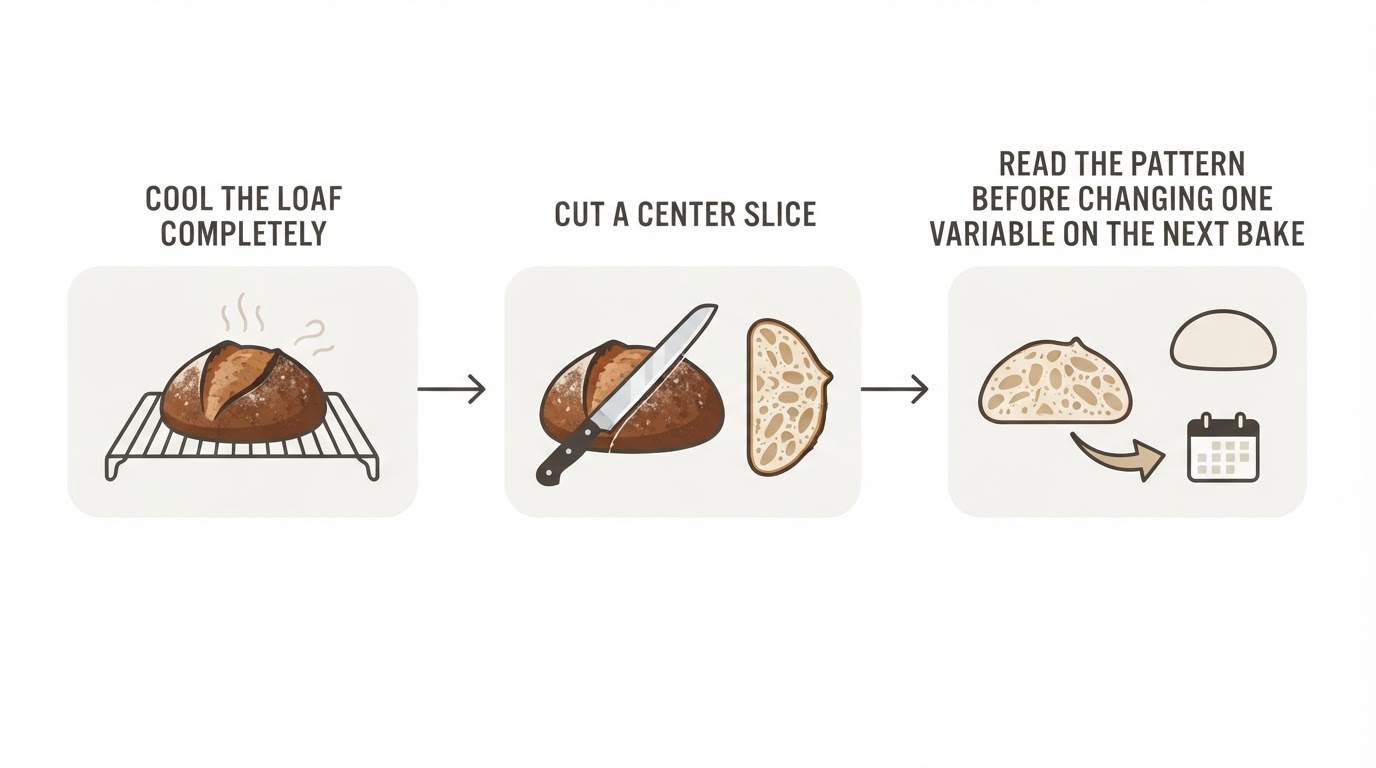
- Bake a baseline. Use the same recipe, and note the dough temperature after kneading, the bulk time and room temperature, the levain's ripeness, and the cold-proof hours.
- Change one lever. Warm the dough to 75°F–78°F, extend the bulk, adjust levain ripeness, or add a little whole grain — one of them, not several.
- Repeat and compare. The test is finished when the same recipe, baked twice, shows a repeatable difference. One lucky loaf is not evidence.
Two limits are worth stating honestly. No single step guarantees a more sour loaf: the acids interact, refrigeration sometimes does nothing, and acetic acid is not "more sour" than lactic acid — it simply has a stronger aroma, so we perceive more tang. And do not chase sourness by over-fermenting: pushing time or temperature past what the dough can take breaks down gluten and gives you flat, gummy bread, not a tangier one.
Use one familiar loaf as your baseline, bake it once as written, then change a single variable so you can compare results.
FAQs
Does a long cold proof always make sourdough more sour?
No. Cold shifts the culture toward acetic acid, which often reads as extra tang, but how much fermentation happened before chilling decides the outcome. A young dough that goes straight into the refrigerator can end up milder, because cold slows the acid-producing bacteria.
Will a warmer, looser, riper starter make my bread more sour?
Those conditions favor LAB in the starter, but they do not transfer automatically to the loaf; dough preparation matters more than starter sourness. Allow roughly ten days for a flour or hydration change to settle before judging it.
Is acetic acid what makes sourdough taste sour?
Partly. Acetic acid has a stronger aroma and is often perceived as sharp sourness, but lactic acid makes up the bulk of the acid in dough and provides most of the actual sourness. Adjusting the balance changes the character of the flavor — a vinegar-like edge versus a yogurt-like roundness — more reliably than it changes intensity.
The bottom line
If your loaf rises but tastes mild, the yeast is fine; the acid side of the dough needs attention. Work through the four levers in order — starter health and ripeness, fermentation time and temperature, the levain build, then cold proofing — changing only one thing per bake. No single trick guarantees more acidity, and over-fermenting is not the shortcut.