Why Acetone Shows Up in a Hungry Starter
When a starter runs low on food, fermentation shifts and the aroma can turn sharp and solvent-like, close to nail polish remover. King Arthur's current sourdough booklet is blunt about this: alcohol, acetone, and vinegar aromas are normal signs that a starter is hungry, not proof that it has spoiled (Sourdough Booklet, 2026). That makes the smell useful as a trigger for checking your routine, but it is only one signal. Aroma alone cannot tell you which microbe or compound is responsible, and it cannot certify that the culture is safe to use. Treat it as a cue to inspect, not a verdict. A solvent-like note is not the only starter aroma worth reading: if your starter smells dairy-like instead, that aroma has its own set of explanations.
Inspect Before You Feed: The Stop Signs
Look and smell before you adjust anything. Throw the starter out and begin again if you see furry white or black mold, or any orange or pink mold or streaks; those colors mean the culture is unsafe. A putrid smell — garbage or rotting food rather than sharp, sour, or yeasty — is the other clear stop sign, because it suggests unwanted bacteria have taken over. King Arthur's guidance on a not-rising starter says the same: an unpleasant, rotten odor with pinkish liquid or visible mold means it is time to toss it and start over (Why is my sourdough starter not rising?). Keep the two cases separate: a sharp, hungry aroma is a signal to review your feeding cycle, while visible contamination is a discard decision. Never taste raw starter, and never assume it is safe to bake just because no mold is visible.
Run a 60-Second Feeding Log
For a culture that shows none of those stop signs, the fastest route to a real fix is to record five facts before you change anything: when you last fed it, the feeding ratio by weight, the room temperature, how high it rose and when it peaked, and what the aroma is now. Repeat the check at the same point in the next feeding cycle. If you decide to change the ratio, the site's sourdough starter feeding calculator scales the flour and water for you.
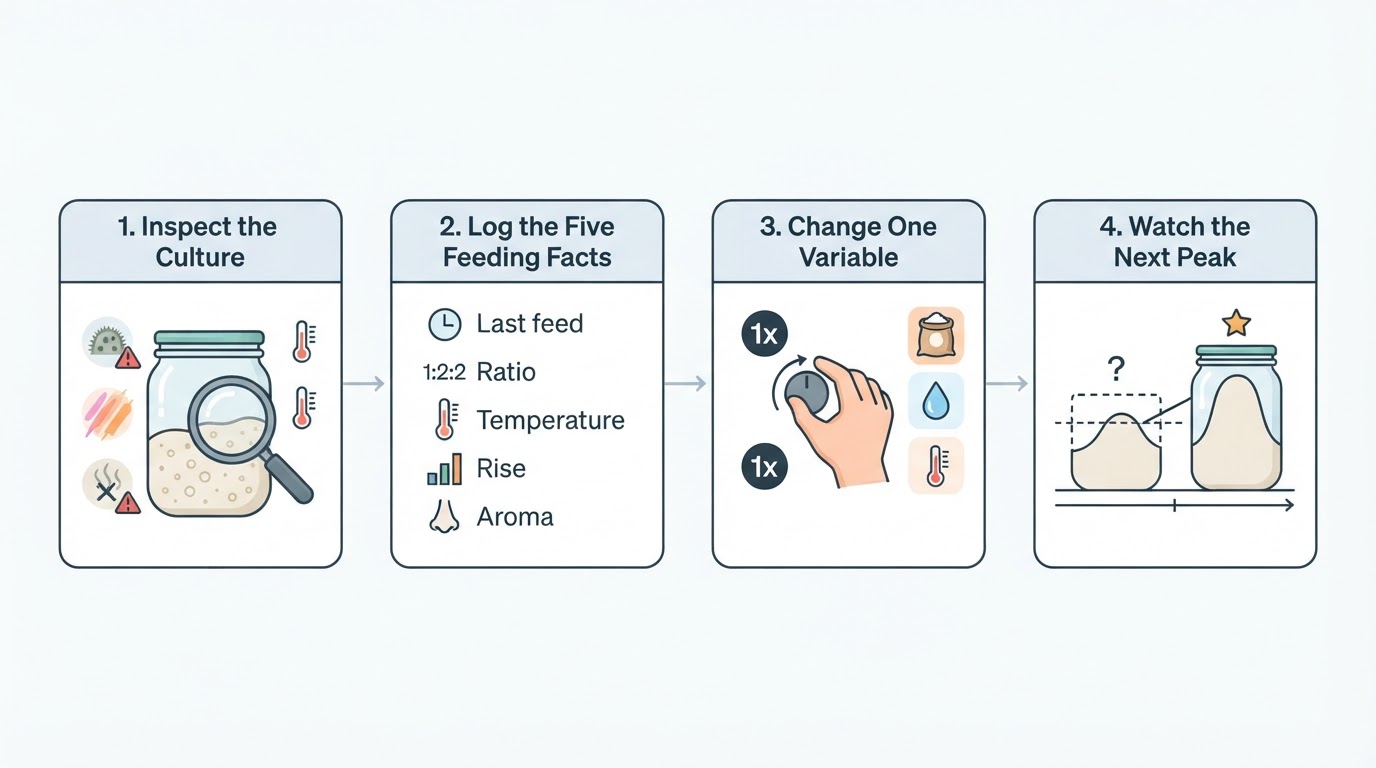
Editorial diagram: the inspect-log-adjust path described in this article, not a photograph of a specific starter.
What you observe | What it may mean | Next check |
|---|---|---|
Solvent-like aroma well before the next scheduled feed | The current ratio or interval may be too small for the kitchen temperature | Note the peak time, then adjust one variable |
Sharp aroma after a missed or delayed feed | The culture ran out of food | Return to your schedule and compare the next two feeds |
Aroma unchanged after several consistent feeds | A routine detail may be blocking recovery | Check temperature, flour, water, and whether you discarded first |
A compact log separates a one-off missed feed from a pattern you can compare after each change.
Change One Variable at a Time
Return to a documented maintenance routine instead of stacking fixes. King Arthur's feeding guide sets out two baselines: keep the starter at room temperature and feed it daily, or store it in the refrigerator and feed it weekly, bringing it back to room temperature and giving it a few feeds before you bake (Feeding and Maintaining Your Sourdough Starter). Change one thing — feeding ratio, feeding interval, or storage temperature — and give the culture two or three feeds before judging the result. There is no automatic 1:5:5 cure, and no guarantee that the aroma clears within 24 to 48 hours. King Arthur's troubleshooting guidance describes a healthy starter doubling roughly six to eight hours after feeding at warm room temperature, with fermentation slowing below 68°F; those figures describe their reference conditions rather than a universal schedule, so compare them with your own logged peak (Why is my sourdough starter not rising?). If progress stalls, adding a little whole-grain flour to the feed can give the culture more nutrients.
Fledgling Culture, Mature Culture
The same acetone note means different things at different ages. A new or young starter can throw off sharp aromas in its first days, and it may rise once and then stall for a week or more even with regular feedings; keep up the maintenance rhythm and compare each feeding instead of expecting a fixed recovery time. A mature culture that has been reliable is a different case. If the aroma appears after a missed or delayed feed, read it as hunger and return to your documented schedule. If it persists despite consistent feeding — especially alongside a slow or missing rise — go back to the log and change exactly one variable, such as the ratio of retained starter to fresh flour and water, or the room temperature, then compare the next peak.
What Recovery Looks Like
Recovery is a trend, not a moment. The aroma should drift back toward yeasty, fruity, sour, and tangy as the culture returns to a predictable rise-and-fall rhythm. When you plan to bake, follow the feeding schedule your recipe documents and the healthy rise pattern your own starter shows after a good feed, and use it while it is ripe rather than after it has begun to fall; a blanket "feed six to twelve hours before baking" interval does not fit every kitchen, ratio, or temperature. If stop signs appear instead of improvement, discard the culture and restart; a fresh start is safer than a rescue attempt.