What Each Rest Contains
A strict autolyse combines only flour and water. King Arthur Baking's guide to the autolyse method describes it as a gentle mix followed by a 20- to 60-minute rest, with the remaining ingredients added afterward. The pause gives the flour time to hydrate and the gluten to begin developing without salt tightening the dough or the starter starting fermentation.
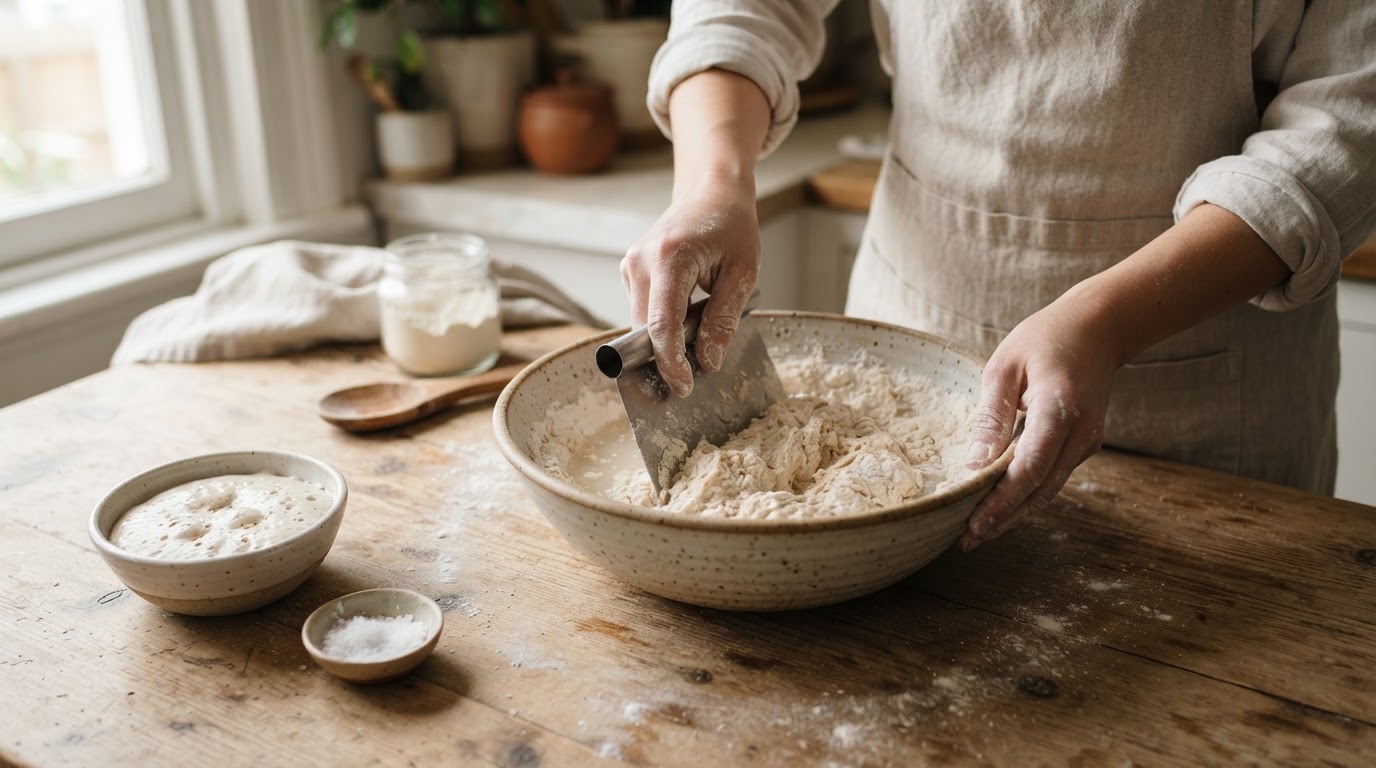
Fermentolyse changes the order: flour, water, and ripe levain go in together, and the salt waits until after the rest. Lockrem Homestead's comparison of the two methods defines it that way and points out the consequence: once the starter is mixed with flour and water, bulk fermentation has begun. The rest is not free time before the clock starts; it is the first part of bulk.
That single difference—whether the starter is in the bowl during the rest—drives most of the practical differences.
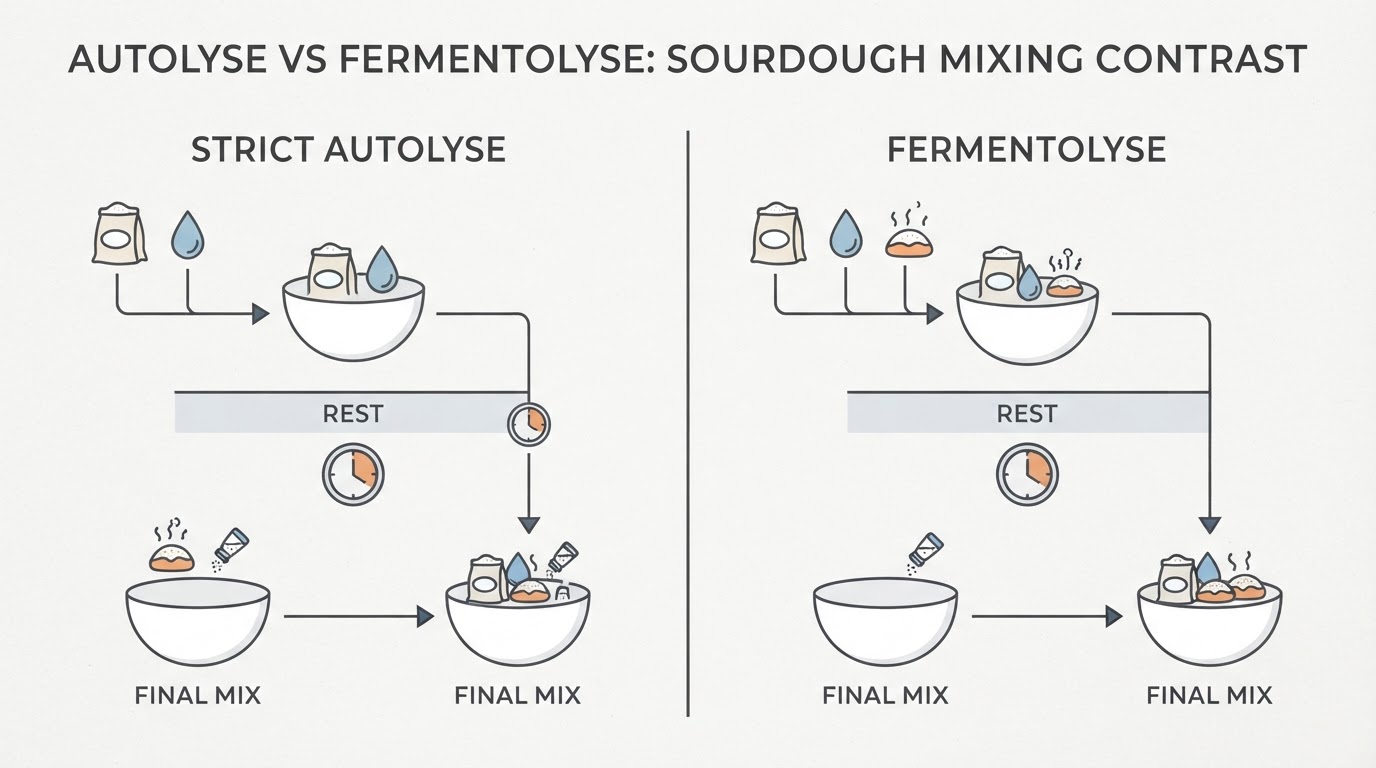
| Strict autolyse | Fermentolyse |
|---|---|---|
What goes in first | Flour and water | Flour, water, and starter |
Held back for the rest | Starter and salt | Salt and any reserved water |
What the rest is doing | Hydrating the flour and starting gluten development | Hydrating the flour while fermentation is already under way |
One terminology caveat is worth knowing. King Arthur notes that when a recipe uses a liquid sourdough starter or preferment, that liquid is included in the autolyse because the flour cannot be properly hydrated without it. So "strict" is a useful default, not a rule every recipe follows; some bakers use "autolyse" loosely for any early rest. The ingredient list tells you which mix you are actually making.
When Does Bulk Fermentation Start?
The clock follows the starter. In a strict autolyse no starter is in the bowl during the flour-and-water rest, so bulk fermentation is conventionally counted from the moment you incorporate it. The rest is not biologically idle—flour enzymes begin breaking down starch and protein as soon as water is added—but it is not counted as fermentation time either. In a fermentolyse the starter is present from the first mix, so the rest is the opening stretch of bulk.
This matters when a recipe gives a bulk window such as "4 to 6 hours" or "until the dough rises by about 50 percent." Suppose the recipe calls for a 30-minute rest and 5 hours of bulk. With a strict autolyse, the 30 minutes happen before the clock starts, so you have about 5 hours of fermentation. With a fermentolyse, that 30-minute rest is the first half hour of the 5-hour bulk; adding a fresh 5 hours after the salt would give you about 5.5 hours of fermentation.
The practical fix is to pick one starting point and use it every time. Note when the starter goes in, then judge the dough by feel and rise as well as by the clock. Two bakers can follow the same recipe and get different timings because flour, hydration, and kitchen temperature all shift the pace.
When a Separate Autolyse Is Worth the Extra Step
A strict autolyse earns its extra bowl time in a few situations:
- Whole-grain or freshly milled flour. Bran takes up water slowly, and as it hydrates it softens and interferes less with gluten development. King Arthur describes that benefit for whole-grain dough; it is a reason a rest can help, not a rule that every whole-grain or freshly milled dough needs one.
- High-hydration or very strong bread flour. A rest can make a slack or tight dough easier to handle. Lockrem lists high-hydration doughs and strong bread flours as good candidates.
- Dough feel. King Arthur's tests found the clearest advantage in handling: the rested dough was softer, more extensible, and easier to shape.
- Scheduling. If you want to delay the starter or salt, a separate autolyse keeps those additions clean and lets the flour hydrate while you do something else.
Even so, a separate autolyse is not automatically better bread. In King Arthur's 2017 tests the results moved around: a full mix and pause won one comparison, a 30-minute autolyse won another, and the author could not detect a consistent difference in crumb color, aroma, or flavor. The advantage that held up was workability, and a rest after mixing all the ingredients together still delivered much of it. King Arthur also advises against an autolyse for sourdough rye, because rye flour does not develop gluten the same way and ferments more quickly.
When Fermentolyse Is the Simpler Choice
Fermentolyse removes a step. You mix flour, water, and starter together, rest, then add salt. That avoids working a stiff starter into dough that has already rested—one of the fiddly moments in King Arthur's autolyse tests. It also suits white-flour breads, where Lockrem notes fermentolyse gives results similar to an autolyse.
The tradeoff is that the clock is already running. Salt slows yeast activity but does not stop it, so a fermentolyse is not a way to pause fermentation; it is a way to start it earlier. Rest too long and the dough can be overproofed by the time the stretch-and-folds and bulk fermentation are finished, which is why Lockrem keeps this rest short.
How Long Should Each Rest Last?
There is no universal number, and the two sources bracket it differently. King Arthur gives 20 to 60 minutes for an autolyse. Lockrem Homestead suggests 30 minutes up to a couple of hours at room temperature, with whole-wheat doughs suited to the longer end. For fermentolyse, Lockrem's ceiling is about an hour before the salt goes in.
Treat each as a starting point rather than a target. Flour type, hydration, and room temperature change how quickly the dough hydrates and ferments: a warm kitchen speeds fermentation, whole-grain flour absorbs water differently from white flour, and a stiff dough will not feel like a wet one on the same schedule. Lockrem also cautions against an overnight autolyse with white flour, which can leave the dough sticky and weak. Overnight timing is recipe-specific in any case—the amount of starter and the temperature set the pace—so follow the schedule your recipe was built around rather than extending a rest.
At the end of an autolyse, the flour should be fully moistened and the dough smoother and more extensible. At the end of a fermentolyse, you may already see bubbles or a slight doming, because the bulk clock started at the mix.
Keeping the Clock Consistent
Whichever method you choose, the number that matters is when the starter went in. Write that time down, along with the dough temperature and how much it had risen when you shaped it. After a few bakes those notes show whether your kitchen runs faster or slower than the recipe's window, and the next adjustment becomes a matter of an hour rather than a guess.
For a complete sequence from starter to baked loaf—including where a short rest sits relative to bulk fermentation—this step-by-step sourdough bread guide shows how the stages fit together in one bake.