Where the 210°F figure applies
King Arthur Baking's no-knead sourdough bread gives an unusually specific finish. After 45 minutes covered at 450°F, you take the lid off and bake 10 to 15 minutes more, "until the crust is well colored and the internal temperature reads at least 210°F" (no-knead sourdough bread, Maurizio Leo, 2020). That converts to 99°C by the usual formula, (210 − 32) × 5/9 = 98.9. Reading the 210 as Celsius instead would keep any loaf in the oven far too long.
The same sentence asks for color and a number at once, and the rest of the recipe fixes the situation those two cues belong to: a lean, high-hydration dough, one large boule, a Dutch oven preheated inside an oven set to 500°F and then dropped to 450°F for the bake. Those conditions are part of the target, not background detail.
If your recipe prints an internal temperature, that printed number governs. A figure lifted from a different formula is a reference point, not an instruction.
Why the reading alone can't settle it
King Arthur's baking team treats temperature as confirmation rather than the decision. In their guide to judging doneness, Annabelle Shippee (2023) quotes Baker's Hotline bread expert Barb Alpern, who learned to bake at an artisan bakery where loaves were never probed at all; she recommends reading aroma, color, feel and sound first and using the thermometer to confirm what those senses already suggest. The reason matters for your bake: "the center of a loaf can reach its 'finished' baking temperature several minutes before the end of baking time," so a reading on its own can mislead (how to tell if bread is done baking, 2023).
Put that beside the 210°F instruction and the two fit together. The number tells you the middle is hot enough; the crust tells you the outside has had the bake this bread needs. For sourdough, internal temperature is the cue you can put a number on, and the crust is the one you have to look at. A loaf can satisfy one and miss the other. When that happens, work out which cue is out of step before changing anything.
Put the probe where it measures the crumb
The reading is only as good as the placement. Aim the tip into the center of the thickest part of the loaf, working in from the side or at an angle, clear of the Dutch oven wall and the hot crust. A probe resting against metal, or one that stops just under the surface, reports the pot or the shell rather than the middle, which is the only place the 210°F figure is meant to describe. Let the number settle before you decide.
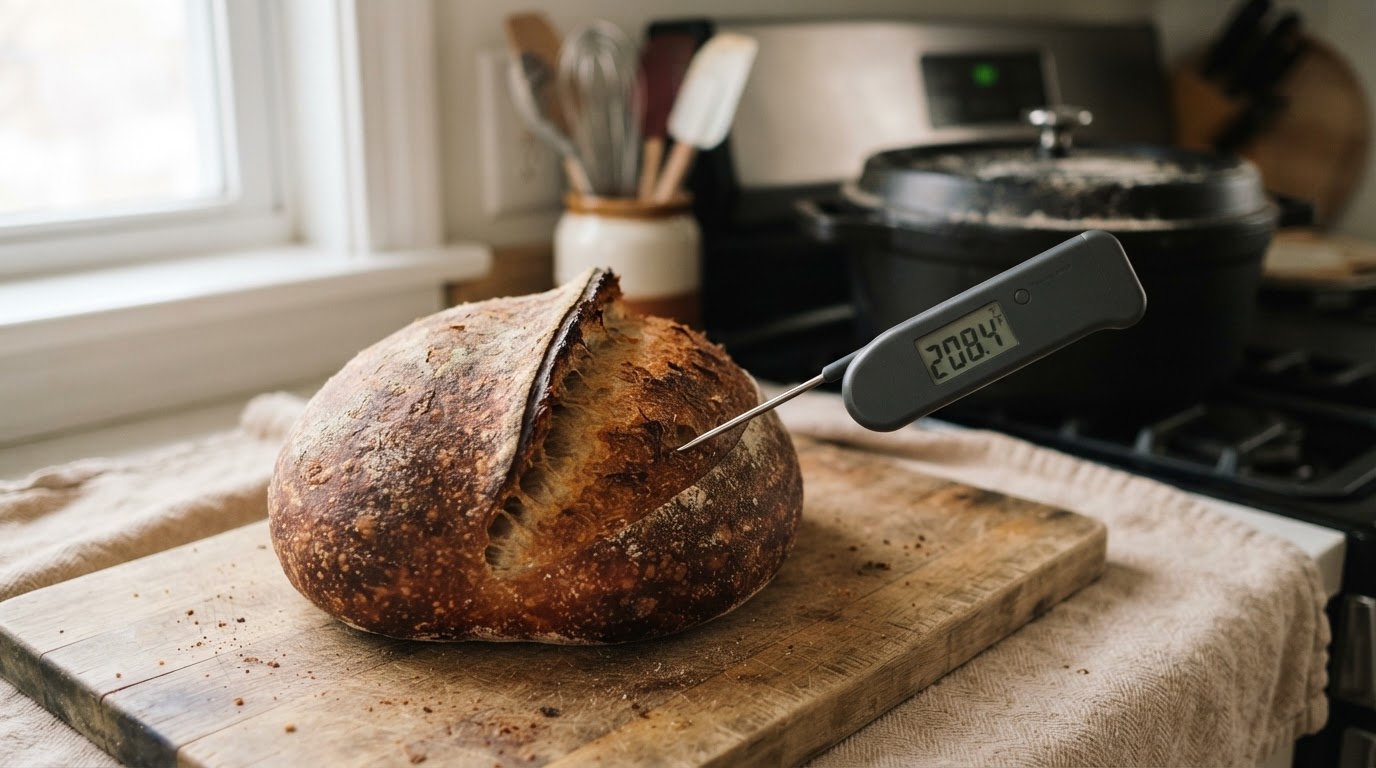
If a reading looks wrong for what the loaf is doing, taking it again in a second spot on a large boule is a quick way to tell a placement mistake from a real difference.
Judge the crust the way this bread needs
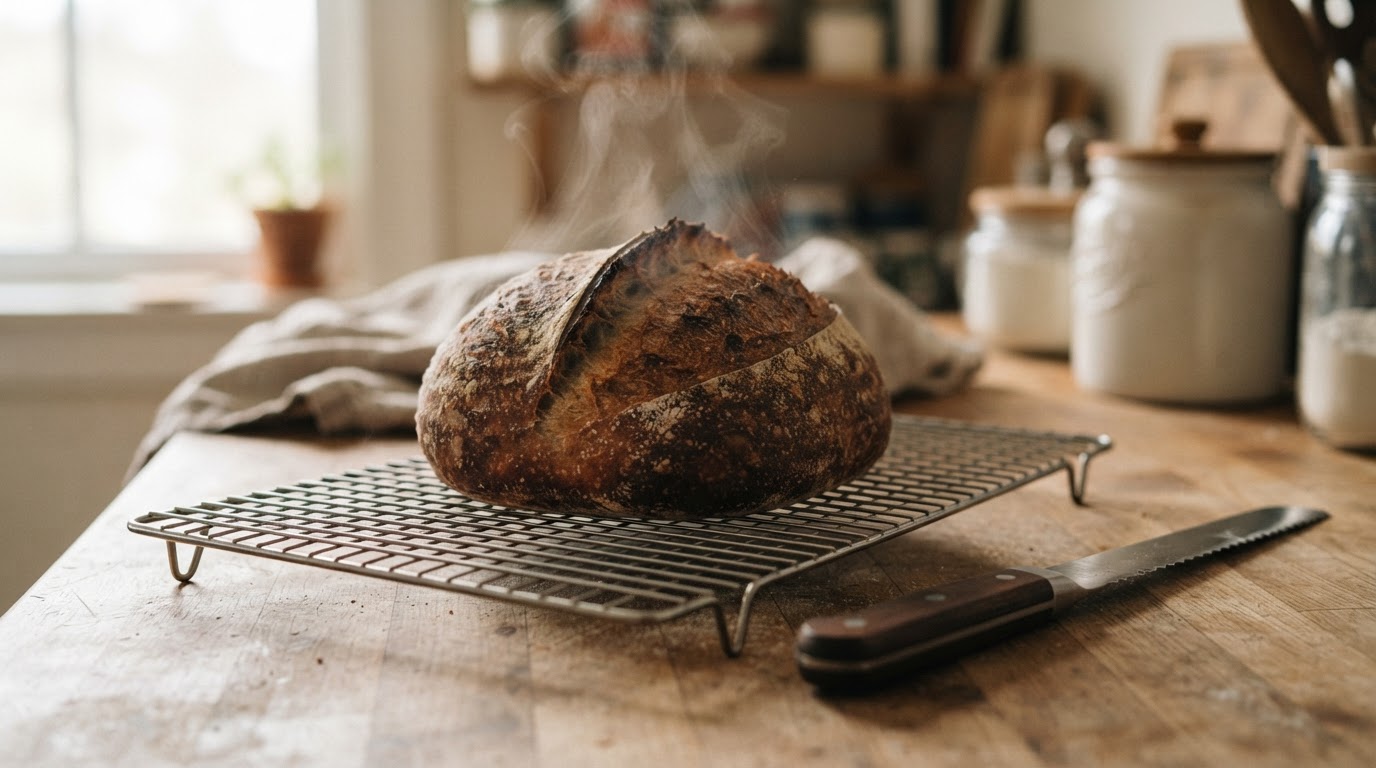
Color is not one standard across baking. King Arthur's doneness guide sets crust targets by loaf type, and the one that belongs to the bread you are baking is the one to judge against. For a crusty sourdough boule, the guide takes the crust dark, to the point where the ear carries a thin strip of char — Alpern's eyeliner test. That darker target is the one that pairs with a 210°F reading.
Sound belongs to the same set of cues in the guide, along with aroma and feel: a finished crusty loaf gives a hollow note when tapped on its base, so handle it with a cloth or oven mitt rather than a bare hand.
When the two signals disagree
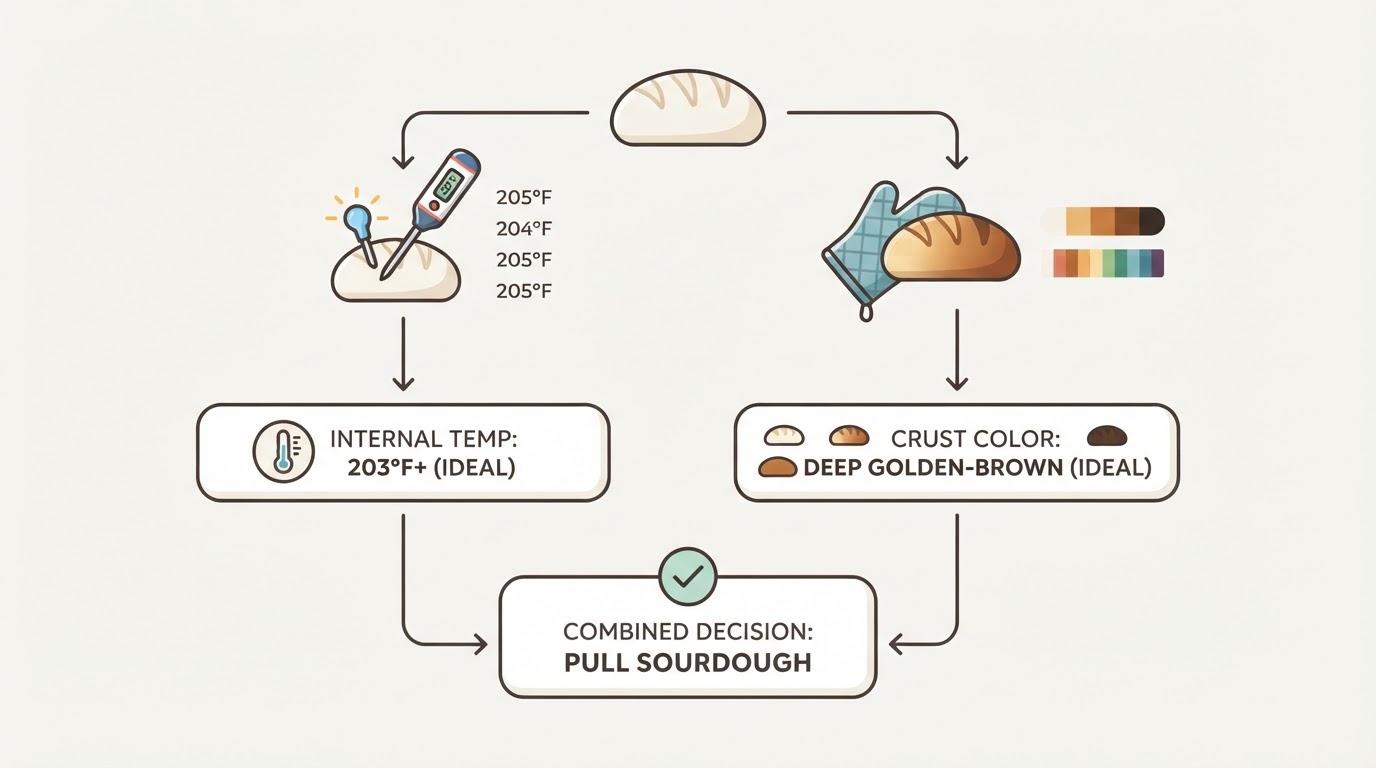
- Center at or above the recipe's temperature and the crust where the recipe wants it: pull the loaf.
- Center at temperature but the crust still pale for this bread: keep baking and follow the recipe's own doneness guidance, rechecking the crust and the probe placement as you go. The no-knead formula's 10 to 15 uncovered minutes describe where the color should be developing, and its endpoint is the well-colored crust together with the 210°F reading — not a fixed number of minutes on its own.
- Crust dark while the center lags: re-check the probe placement first, then take a second reading elsewhere. If the middle genuinely is behind, keep following that recipe's instructions for the rest of the bake. One dark exterior and one low reading do not establish an oven fault.
What none of this supports is a single pull temperature applied to all sourdough. A pan loaf, an enriched dough and a rye formula move color and center at different rates, and each one carries its own printed endpoint. Rye asks for particular patience: dense rye breads are moist enough that King Arthur's guide notes they can benefit from up to 24 hours of cooling. A 210°F finish borrowed from a Dutch-oven boule says nothing useful about a sandwich loaf in a tin.
Cool it before you cut it
Set the loaf on a rack out of the pan or Dutch oven and leave it until the center and the base no longer feel warm. Alpern's warning is direct: bread is not fully done when it leaves the oven, moisture keeps leaving, the internal structure needs time to set, and slicing early is how you get the gummy interior you were trying to avoid. The no-knead recipe asks for at least an hour on a rack before slicing. How long that takes varies with the loaf — mass, hydration, flour and airflow all move the window, so a 1 kg boule and a small pan loaf are not on the same clock. How long to let sourdough bread cool before slicing covers that cooling window and the slicing checks in more detail.
A loaf cut while still warm smears under the blade and turns sticky at the cut face, which is a cooling effect. A loaf that is fully cool and still gummy has several possible causes — hydration among them, alongside the bake and fermentation — so more cooling time will not answer it on its own.