The short answer: salt is a percentage of total flour
Salt percentage in bread is a baker's percentage: salt weight divided by total flour weight, multiplied by 100. "Total flour" means every gram of flour in the dough, which includes the flour you weigh for the final mix and the flour that arrived inside your sourdough starter.
King Arthur Baking's professional salt reference puts the usual bread range at 1.8% to 2% of flour weight. Its 2022 guide to baker's math gives a slightly wider 1.8% to 2.2%. Those are reference ranges from one established baking source, not a universal safe or optimal threshold; your flour, formula, and taste still decide the number. What does not change is the denominator. Leave the starter's flour out and you are no longer calculating salt as a percentage of the flour in the loaf.
Find the flour inside your starter
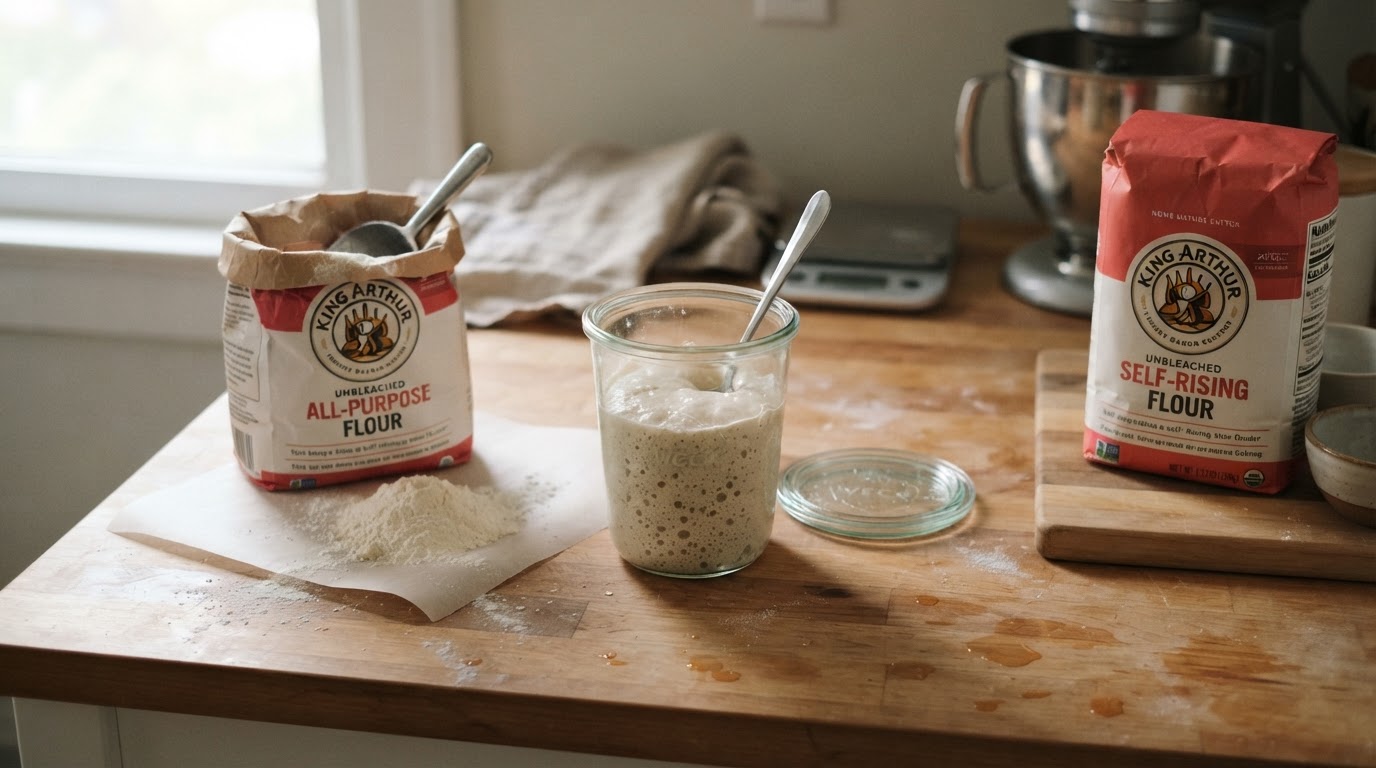
Starter is flour and water, so part of its weight is flour. Assuming the starter contains nothing but flour and water, and that the stated hydration describes the whole jar rather than one feeding, the flour share is:
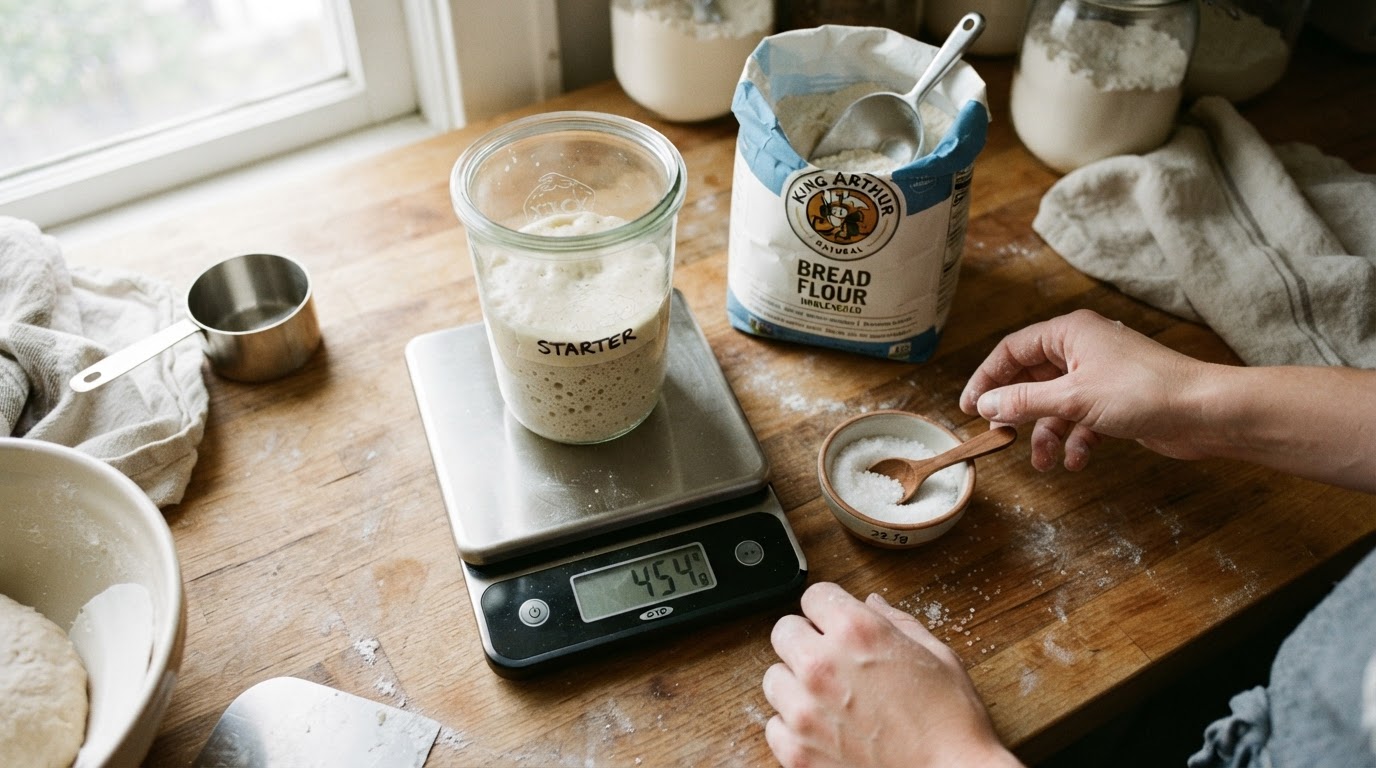
starter flour = starter weight / (1 + hydration / 100)
At 100% hydration, which means equal weights of flour and water, 100 g of starter contains 50 g of flour and 50 g of water. At 50% hydration the same 100 g holds about 66.7 g of flour and 33.3 g of water. For how the two consistencies behave differently, see stiff versus liquid sourdough starters. The table below spares you the arithmetic for common starters.
Starter weight | Hydration | Flour in starter | Water in starter |
|---|---|---|---|
100 g | 100% | 50 g | 50 g |
100 g | 75% | 57.1 g | 42.9 g |
100 g | 65% | 60.6 g | 39.4 g |
100 g | 50% | 66.7 g | 33.3 g |
200 g | 100% | 100 g | 100 g |
The fraction comes from the flour-to-water ratio, so the type of flour in the starter does not change it. Sixty grams of whole wheat or rye is still sixty grams of flour in the denominator. What can change the count is the water figure. If the number on the jar describes only the latest feeding while older starter carried over, the jar as a whole can be slightly wetter or drier than that number implies.
When you know the build amounts, skip the percentage and total the parts. A starter made from 50 g flour and 50 g water is a 100% hydration starter no matter what the label says. If a build starts from 50 g of mature starter and adds 50 g flour and 50 g water, the seed brings its own flour and water with it, and only the ingredient amounts tell you how much flour is really in the jar.
Calculate salt in three steps
- Write down the flour weighed for the final mix.
- Add the flour contained in the starter, unless the recipe's flour line already includes it. The next section explains how to tell.
- Multiply total flour by the salt percentage and divide by 100. If a recipe gives salt in grams instead of a percentage, divide that salt weight by total flour and multiply by 100 to read it as a percentage.
Example A: 100% hydration starter. You weigh 500 g of bread flour and add 100 g of starter at 100% hydration. That starter is 50 g flour and 50 g water, so total flour is 550 g. At 2%, salt is 550 x 2 / 100 = 11 g. At 1.8% it is 9.9 g, and at 2.2% it is 12.1 g. Reverse check: 11 / 550 x 100 = 2.0%.
Example B: 50% hydration starter. The same 500 g of flour and 100 g of starter, this time at 50% hydration. The starter contributes about 66.7 g of flour, so total flour is 566.7 g. At 2%, salt is about 11.3 g.
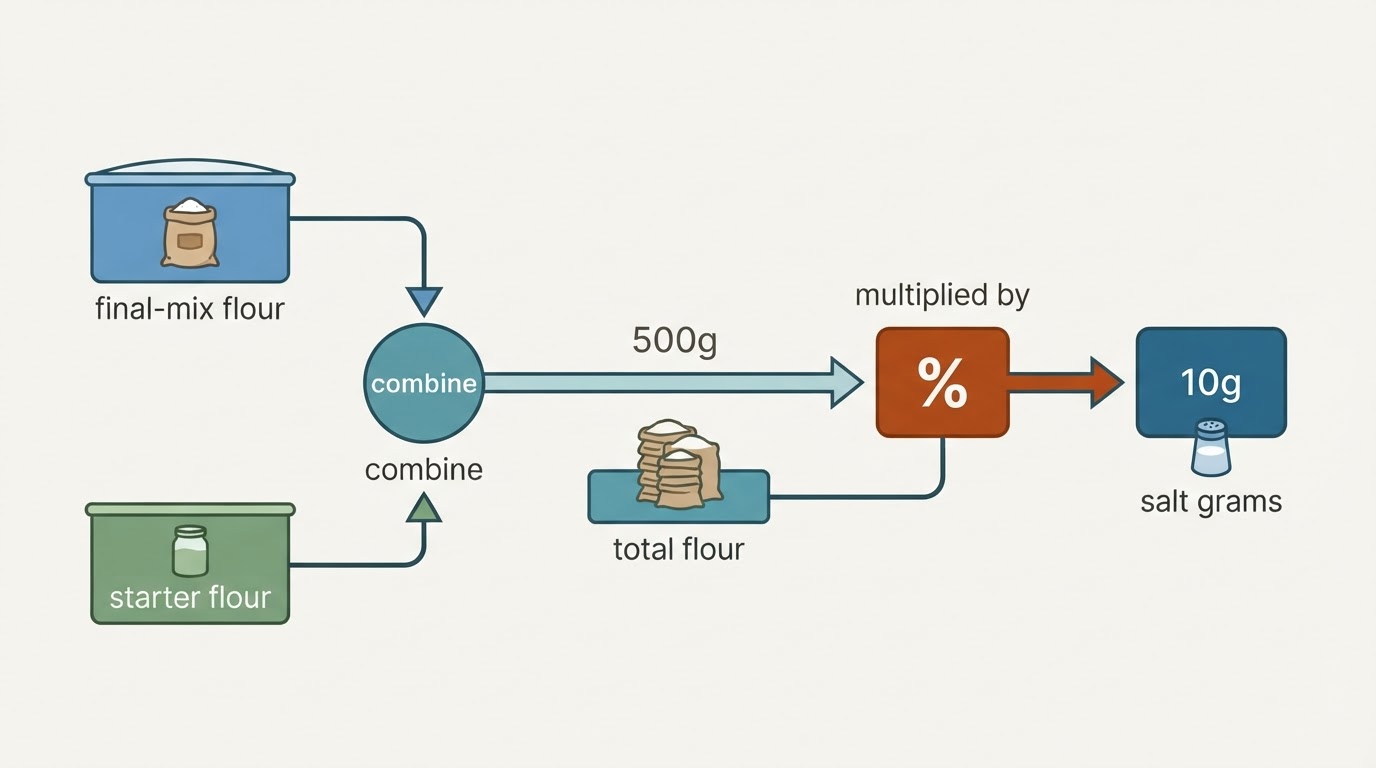
Both examples assume a starter made only of flour and water. If salt is already present in the starter or in another component you are counting, add it to the total salt weight so the percentage describes the whole dough.
Does the recipe's flour line already include the starter?
Recipes count flour in two different ways, and only one of them needs starter flour added:
- Final-mix flour. The ingredient list covers only what goes into the final dough. Starter flour sits outside that number and must be added.
- Total formula flour. The list already includes the flour in the preferment. Adding starter flour again double counts it.
King Arthur's baker's math guide describes the relationship: the total formula holds everything, and the final mix is the total formula minus the preferment ingredients. A recipe that publishes a total-flour or total-formula figure has already counted the starter, so there is nothing left to add.
The ingredient list on its own does not settle which convention a recipe uses. Seeing sourdough starter as a separate line does not prove the flour line already contains the starter's flour; both conventions can look identical on the page. What settles it is an explicit definition, either a stated total flour or total formula, or a build you can audit line by line, such as a levain whose flour and water are listed separately. With a build like that, you total the flour yourself and know the count is complete.
When the convention stays unclear and no build is given, ask the recipe's author or check the method notes rather than picking one. The gap is not trivial: on a 100 g starter at 100% hydration it is 50 g of flour, which shifts 2% salt by about a gram.
Keep the salt in grams, not teaspoons
If you searched for how much salt in sourdough bread in teaspoons, the practical answer is to stop at grams. Table salt, kosher salt, and flaky sea salt have different crystal sizes and densities, so the same spoon volume holds different weights. Your flour is already weighed in grams, and the salt percentage is a weight ratio. Keep salt in grams from the start and the arithmetic stays consistent.