The Short Answer: Yes, With a Preference
Can you use bleached flour for sourdough starter? Yes. Bleached flour is not poison to a sourdough culture, and the more useful question is what you should expect from it. King Arthur Baking's guidance for new sourdough bakers says bleached flour may eventually yield a decent starter, but that it will probably take considerably longer to become fully active. That is their experience-based expectation, not a universal rule.
So the practical answer splits in two. For a brand-new starter, begin with unbleached flour and give the culture the more predictable starting conditions. For an established culture, one bleached feed is not a reason to throw the jar out, but it is a reason to return to your usual flour and watch what happens over the next feeds.
One clarification about scope: this guide is about maintaining a culture, not about substituting bleached flour in a tested bread formula. A starter that behaves differently after a feed does not tell you, by itself, how a loaf made with bleached flour would turn out. Choosing flour for the final dough is a separate recipe question with its own variables.
What Bleaching Changes in the Flour
Bleaching speeds up the natural whitening and aging of flour. King Arthur's consumer explanation is that the flour's natural flora is killed by bleaching, which is why their guidance expects a starter made with bleached flour to take longer to become fully active. Keep that as their explanation rather than a universal law.
It helps to be precise about what is happening in the jar. The microbes in a starter ferment the flour and water you give them; the flour itself is the material being transformed, not a food that microbes hunt or graze on. Flour also carries its own wild yeast and bacteria, and bleaching affects that population. How much it affects a given bag depends on the treatment and the product, which is why a single word on the packaging cannot predict your result.
Treat the claim as directional. Unbleached flour is the more predictable starting point, and bleached flour is likely to be slower rather than instantly fatal. Different millers treat flour in different ways, and "bleached" does not tell you exactly what was done.
That distinction matters because it is easy to jump to the dramatic version. A slow starter is not the same as a dead one, and King Arthur's troubleshooting guidance is to keep feeding a sluggish starter rather than assume the culture is finished. That is a more proportionate response to one accidental bleached feed.
Starting a New Starter vs. Feeding an Established Culture
These two situations get mixed together in most quick answers, and they should not be. The table below separates them.
Situation | What you can reasonably expect | Sensible next move |
|---|---|---|
Starting a new starter with bleached flour | The culture may take longer to become fully active; the label alone does not predict how much longer | Switch to unbleached all-purpose, and consider adding a little whole wheat or rye if you have it |
Feeding an established culture bleached flour | A healthy culture may keep rising normally; one feed does not show whether it was affected, and the label does not settle it | Return to your usual unbleached flour at the next feed and compare the next few feeds with the culture's own history |
One accidental bleached feed | Possibly a delay; one feed is not evidence of cause or outcome | Keep the culture, resume the routine you know, and observe repeated feeds under that routine |
For a new starter, King Arthur recommends whole-grain flour as a useful option because the wild yeast a starter needs is more likely to be present in a mineral-rich whole-grain environment (best flour for sourdough starter). That is not a requirement, and all-purpose flour still works. It is simply a way to give a new culture different material to work with. It is not a guaranteed boost, and it does not come with a fixed effect on flavor.
If You Just Fed Bleached Flour by Accident
First, do not dump the jar. One feed does not show that the culture is dead, and King Arthur's troubleshooting advice is to keep feeding a sluggish starter rather than start over.
Here is a conservative check you can run:
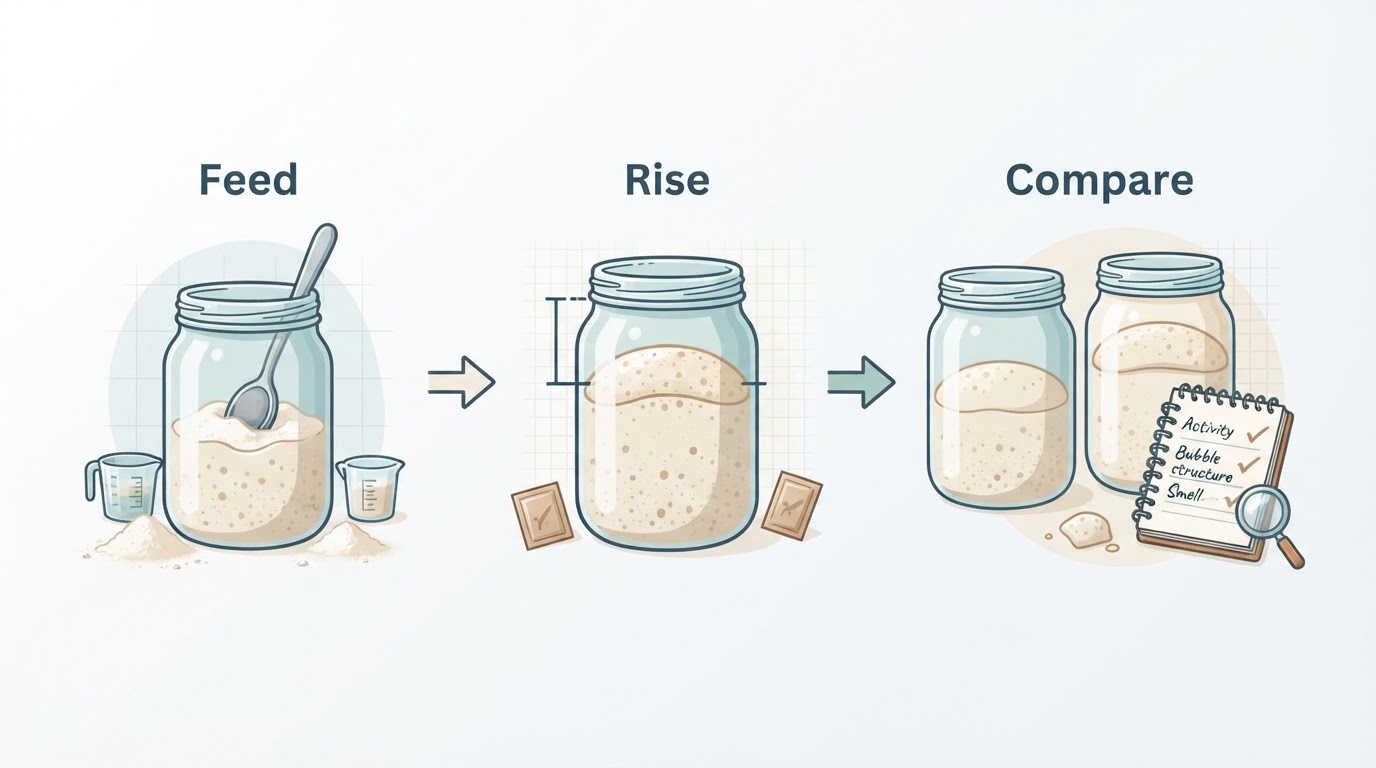
- Return to your known routine. Use the same unbleached flour, the same ratio and the same feeding schedule you used before the slip. Changing three things at once tells you nothing.
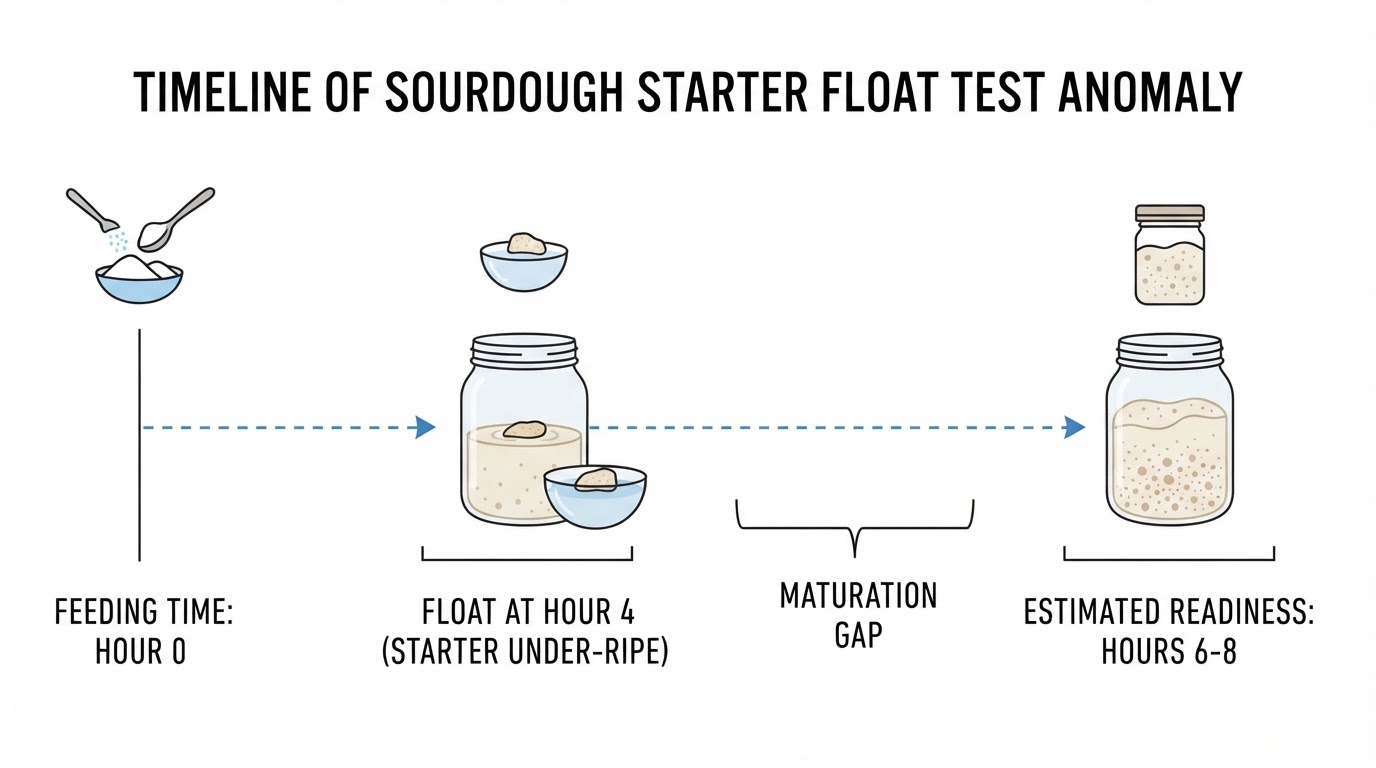
- Observe repeated feeds. Two or three feeds is a sensible place to start a record, not enough to settle the cause or to prove anything universal about readiness. Keep feeding and keep noting what you see.
- Compare the rise with the culture's own history. Look at how long it takes to reach its usual high point and whether it holds there, rather than measuring against a number copied from someone else's kitchen.
- Look at the top and the inside, as observations rather than a verdict. A domed top, a spongy webbed interior and a familiar tangy smell are signs of activity, not proof that the culture is safe to use.
- Keep a short log. Date, flour used, hours to peak, and smell. A few consistent lines will tell you more than a forum thread, though they still describe one jar rather than a recovery rule.
Our sourdough starter guide covers the day-to-day feeding check and the appearance and smell cues in more detail.
None of this is a guaranteed rescue, and no fixed number of feeds or hours can promise recovery. It is a way to make a decision with evidence from your own jar instead of from the label.
What Flour Works for Maintaining a Starter
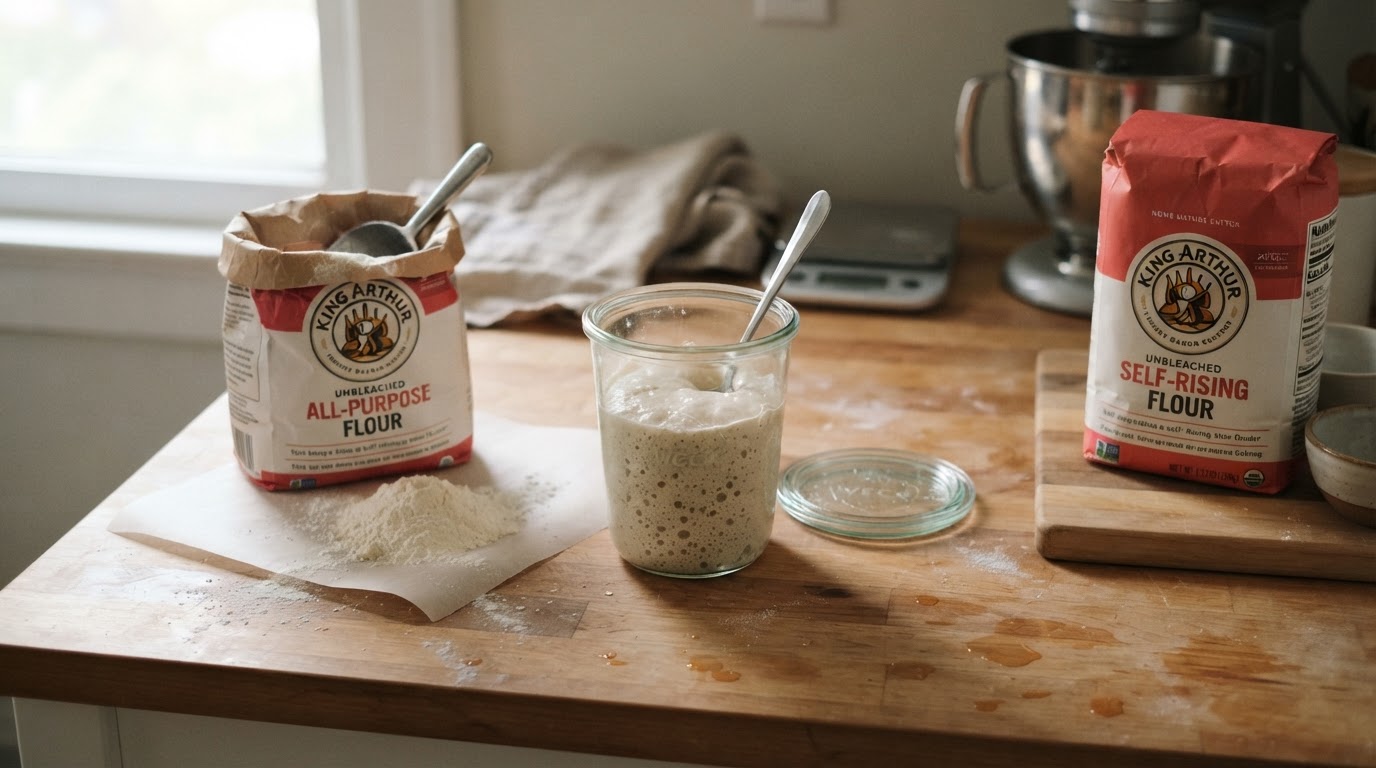
For maintenance, all-purpose flour is the simplest reliable choice. King Arthur's current flour guidance calls all-purpose a great choice and notes that regular feedings with it keep a starter thriving.
This is also where the "can I use bread flour for sourdough starter?" question comes in. Yes, you can. You do not need it. Bread flour's higher protein helps build a strong gluten network in dough, but a starter does not need a developed gluten network, so the extra protein is not doing the job people assume. Some bakers prefer it; King Arthur's view is that it will not make much difference either way.
Whole wheat and rye are useful optional ingredients rather than requirements. Both are whole grains, and rye is a different grain from wheat rather than a wheat type or a protein level, so it behaves differently in a culture. King Arthur suggests whole-grain flour when starting a new culture and describes occasional whole-grain feeds as a way to give a white-flour starter more minerals and microbes to work with. That is a reasonable variation to try, not a guaranteed fix for a sluggish culture and not a promise of a particular flavor.
If you keep one flour on hand, keep unbleached all-purpose. If you keep two, add whole wheat or rye for starting and for the occasional change of pace.
How to Read the Flour Label
The bag tells you less than the recipe debate suggests, but it is still worth reading carefully.
- "Unbleached" is the term to look for. It is the clearest statement that the flour was not bleached.
- "All-purpose" and "bread" describe intended use and protein conventions. They do not tell you whether the flour was bleached.
- "Whole wheat" and "rye" describe the grain and how it was milled. Rye is not a type of wheat and not merely a protein level; it is a different grain with different behavior.
- If the package does not state whether the flour was bleached, check the manufacturer's information for that specific product. Do not assume a treatment just because the word "unbleached" is missing from the front of the bag.
- Check the date and the storage conditions. Old or poorly stored flour is one more variable, and it is easier to rule out than to diagnose later.
Why You Will See Conflicting Advice
King Arthur's consumer guidance leaves room for bleached flour: it may eventually yield a decent starter, but more slowly. The same publisher's professional preferment reference is stricter. It calls unbleached and unbromated white flour the appropriate choice and describes bleached flour as unsuitable.
That is a genuine difference in recommendation, and it explains why you can find a confident "yes" and a confident "no" in the same afternoon. The reason for the difference is not documented in either piece, so it is better to leave it as an open question than to invent an explanation about professional kitchens versus home bakers. What you can say is that the advice is not unanimous.
What no source can give you is a guaranteed schedule. There is no universal number of days for a bleached-flour starter to become active, no reliable promise that it will recover after a particular feed, and no rule that says one bleached feed ruins a culture. Keep conditional facts conditional: if your starter was healthy before the feed, it has a reasonable chance of showing you that again; if it was already sluggish, the flour is only one variable among several.
When the Problem Is Not the Flour
Sometimes a starter stalls for reasons that have nothing to do with bleaching. A cold kitchen, an irregular feeding schedule and heavily chlorinated water are all common causes, and they are worth ruling out before you blame the bag.
There is one situation where you should stop troubleshooting and deal with contamination. Pink, orange or fuzzy growth means the affected starter should be discarded and the container and tools cleaned thoroughly. You do not necessarily have to throw away the whole glass jar, but you do need to remove the affected culture and sanitize everything it touched before starting again. Our sourdough starter guide is direct about contamination, and switching flour will not make a contaminated starter safe.
Smell and appearance are useful observations, not a safety test. A starter that looks and smells normal is not proof that nothing unwanted is present, so when contamination is suspected, rely on the visible signs and err toward cleaning and starting fresh rather than baking with it.
A Practical Flour Plan
- Buy unbleached all-purpose as your default, and keep the bag sealed and labeled.
- Keep a small amount of whole wheat or rye for new starters and occasional variation.
- Write the flour type and date on the jar or in a note, so a future feed is not a guess.
- If you are stuck with bleached flour, keep feeding and compare the culture with its own history rather than assuming failure.
- Judge the culture by rise, texture and smell over repeated feeds under a stable routine, and treat those observations as clues rather than proof.
The Bottom Line
Yes, you can use bleached flour for sourdough starter, but unbleached flour is the reliable recommendation, especially for a new culture. If you fed bleached flour by accident, keep the jar, return to your usual routine and observe repeated feeds under that routine. Two or three feeds is a place to start a record, not a way to settle the cause or prove a universal readiness rule. Judge the culture on its own behavior, and remember that this guide covers culture maintenance rather than a tested substitution in final bread dough.