Hydration is the number that separates the two
Starter hydration is a weight ratio, not a volume guess. Divide the water weight by the flour weight and multiply by 100. Equal weights of flour and water give 100% hydration; twice as much flour as water gives 50%; five times as much water as flour gives 500%.
The part that trips people up is the starter you carry over. It already contains flour and water, so those grams belong in the total. When you build a starter, you are choosing the flour and water in the retained starter plus the flour and water you add.
What counts as stiff or liquid
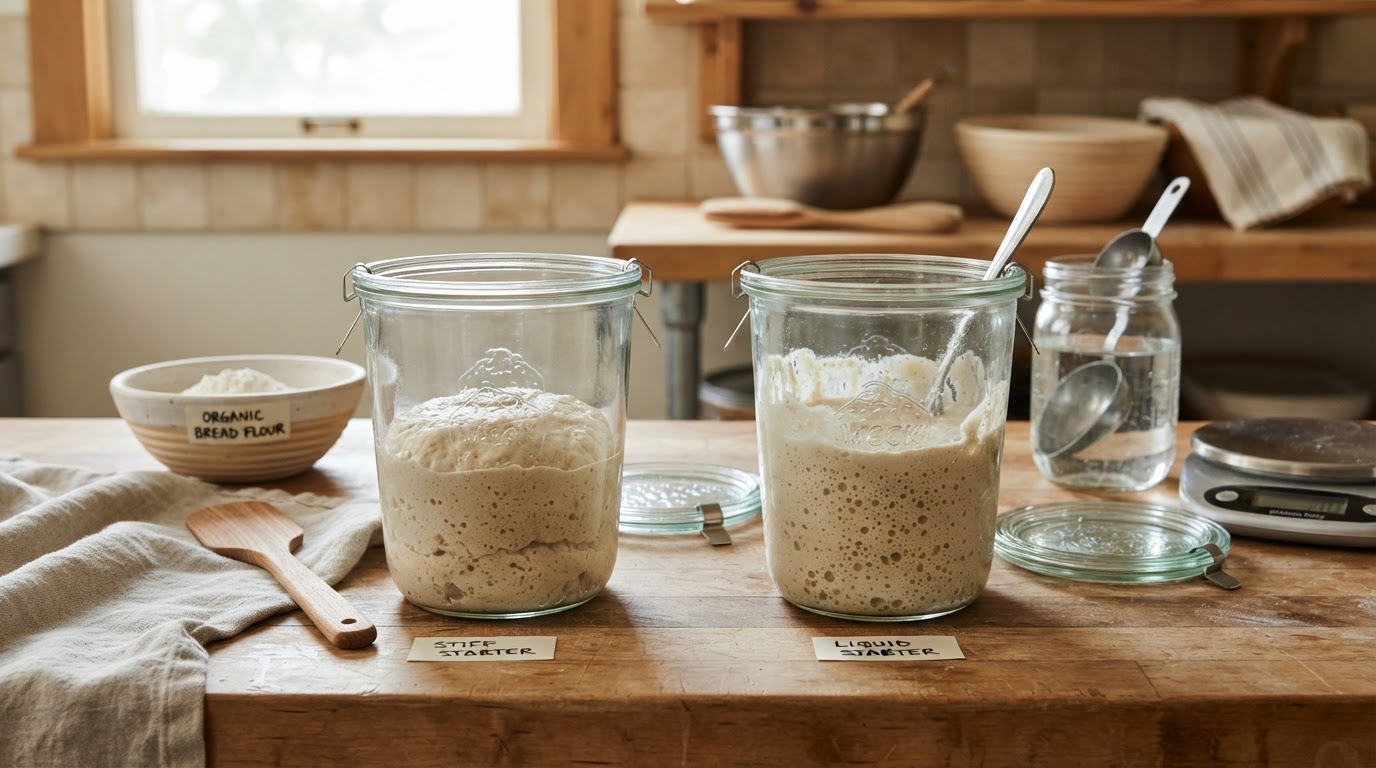
The Bread Code author Hendrik Kleinwächter uses three working labels: a regular starter at 100% hydration, a stiff starter (lievito madre) at 50-60%, and his very liquid experiment at 500%. In his comparison, the same 100 g of flour carries 100 g of water in a regular starter, 50-60 g in a stiff one, and 500 g in the liquid one.
The labels are useful shorthand, not a universal standard. One baker may call a 100% starter liquid simply because it can be stirred, while someone else reserves the word for a pourable batter. Treat 500% as one deliberately extreme liquid version, not as the definition of every liquid starter.
Style | Water per 100 g flour | How it feels |
|---|---|---|
Stiff | 50-60 g | Firm, dough-like, holds its shape |
Regular | 100 g | Thick batter, equal parts by weight |
Very liquid | 500 g | Pourable, closer to a slurry |
Feeding by weight to reach a target hydration
Use a scale and work backward from the amount of starter you want. For a target weight and hydration, flour is the total divided by 1 plus the hydration as a decimal, and water is whatever is left.
Flour weight = target starter weight ÷ (1 + hydration)
Water weight = target starter weight − flour weight
So for 150 g of starter at 50% hydration, you need 100 g of flour and 50 g of water. For 100 g at the same hydration, you get about 66.7 g of flour and 33.3 g of water. Those two numbers are worth noting down, because you will use them again when the starter meets a bread formula.
Converting from a regular starter is the same arithmetic with the retained starter counted. Take 50 g of a 100% starter: it holds 25 g of flour and 25 g of water. Add 75 g of flour and 25 g of water and you have 150 g at 50% hydration, made of 100 g flour and 50 g water. Nothing is lost; the seed simply becomes part of the total.
If you are building a starter from scratch or checking that yours is active enough to convert, the site's sourdough starter guide walks through the build and maintenance.
Keeping the flour and water in your bread formula balanced
A recipe that calls for 100 g of starter assumes a hydration. If yours is different and you use the same weight, you quietly change the dough's flour and water.
Say the recipe expects 100 g of 100% starter: 50 g flour and 50 g water. You have a 50% starter, so 100 g of yours is about 66.7 g flour and 33.3 g water. To keep the formula where it started, take about 16.7 g out of the recipe's added flour and add about 16.7 g extra water. The dough then sees the same total flour and water, even though the starter jar looks different.
Balancing those totals does not guarantee the same leavening rate or the same amount of prefermented flour, because a stiff and a liquid starter can still behave differently in the dough. Adjust the recipe's added flour and water rather than shrinking the starter, and note the change so the next bake starts from a known point.
A watery starter is not the same as a deliberately stiff one
A liquid starter is a maintained choice: a high, weighed hydration that you feed on purpose. A watery starter that is supposed to be moderate is a repair problem. Those are different jobs.
When a starter you meant to keep at a normal consistency turns wet or separates, weigh the next feed back to the hydration you want and hold that ratio for a few feeds. Do not conclude that the starter has "become liquid" and start cutting water out of every feed, and do not treat the wet jar as evidence that a stiff starter is the better keeper. A stiff starter is maintained at 50-60% because that is the ratio you chose, not because you removed water from a neglected one.
If you plan to convert either way, keep a small backup of the original starter first. It is optional insurance that costs little.
What the water change may do in the dough
Hendrik's balloon test is a useful observation, not a rule. He fed starters at 50%, 100% and 500% hydration from the same source starter and measured how much each inflated a balloon. The 50% starter inflated it most, the 100% starter next, and the 500% starter least. He also reports that his stiff starter worked with a cheap low-gluten flour and produced a fluffy, mild loaf.
Those results belong to his kitchen and his cultures. They do not prove that a stiff starter will always rise faster or taste less sour in yours. Flavor depends on which microbes you have, and he describes his own liquid starter turning mild and dairy over time.
Choosing between stiff and liquid
If you want a starter that behaves like dough and takes up little space in the fridge between bakes, a weighed 50-60% stiff starter is the straightforward build. If you want a pourable starter, maintain it at a hydration you can name and repeat, without assuming every liquid starter is a 500% experiment.
Either way, the jar lid is a good place for three notes: the target hydration, the total weight you feed to, and the date. Once those are written down, switching between a stiff and a liquid starter becomes arithmetic you can repeat rather than a change you have to guess at.