The short answer: a conditional yes
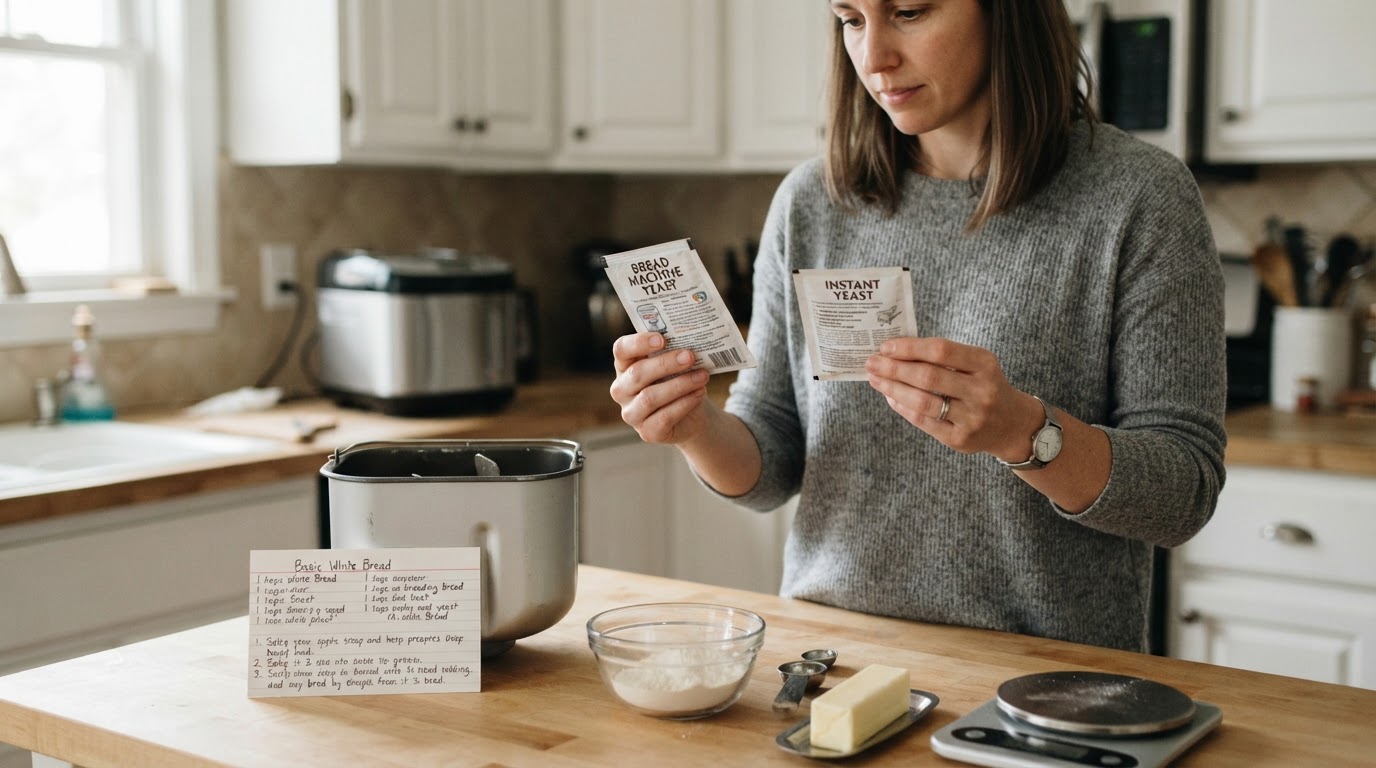
If your package is one of Fleischmann's named instant products, the manufacturer's FAQ treats Bread Machine Yeast and Instant Yeast as interchangeable, but only for the products it names (Fleischmann's FAQ). The practical answer is therefore a conditional yes: you can use instant yeast in a bread machine when the exact package, the recipe and the machine instructions all allow it. Keep the recipe amount and the program you already use unless one of them says otherwise.
What the labels mean
Bread Machine Yeast is milled finer and includes ascorbic acid for loaf volume and structure. Those traits suit machine mixing; they do not make the yeast machine-only. RapidRise PLUS is the exception in that line: it carries a dough enhancer, works in recipes such as white bread, challah and cinnamon rolls, and is not recommended for sourdough. Fleischmann's bread-machine tips allow an equal amount of RapidRise PLUS in a familiar machine recipe (Fleischmann's baking tips). Treat that as advice for that product, not a conversion rule for other yeasts.
Machine programs split the work differently. A dough or manual cycle mixes, kneads and proofs, then stops so you can shape and bake. A bread-baking cycle also bakes the loaf. The program decides which steps the machine controls, which is why it belongs in the decision next to the label.
A same-family comparison at a glance
The table keeps the comparison inside one product family and gives active dry yeast its own row, because it is a different question.
Product label | Preparation | Bread-machine use | What to check |
|---|---|---|---|
Fleischmann's Bread Machine Yeast | Follow the package directions. | Follow the package amount and the machine cycle. | Exact product, package amount, cycle. |
Fleischmann's Instant Yeast | Follow the package directions. | Use it when the package and recipe allow the swap. | Recipe and package approval; keep the written amount. |
Fleischmann's RapidRise Instant Yeast | Follow the package directions. | Run the program the package or recipe specifies for that product. | Whether the recipe was written for your machine cycle. |
Fleischmann's RapidRise PLUS Instant Yeast | Follow the package directions. | Follow the manufacturer's stated replacement for that product. | Sourdough and recipe-type limits. |
Active dry yeast (Red Star example) | Rehydrate or blend with dry ingredients only as that product's package permits. | Use the bread-machine quantity the brand publishes for that product. | The brand's own quantity guidance; no universal ratio. |
The table is deliberately small: exact product, preparation, machine use and the one thing to verify.
The four-step substitution check
Work through these four checks in order before you change the yeast amount or the machine program.
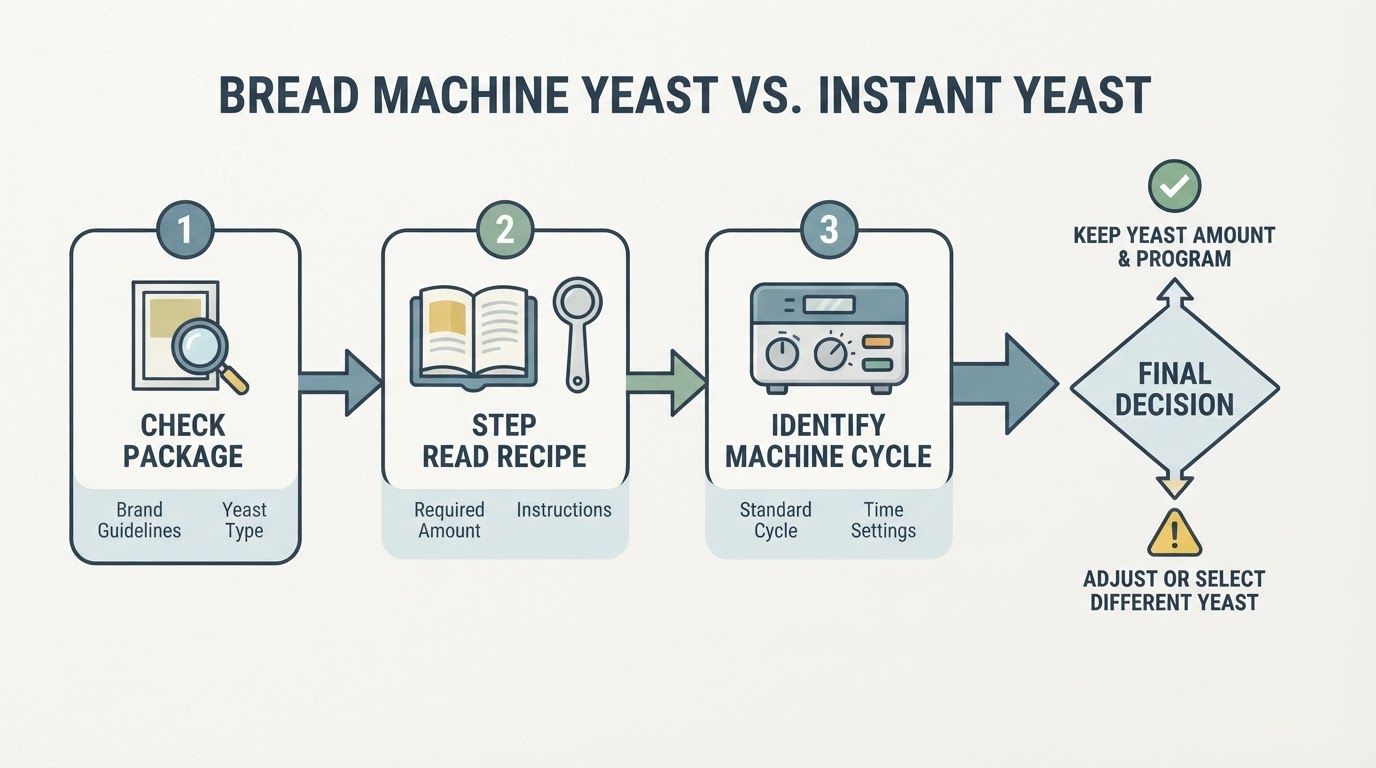
- Read the package. Identify the exact product, its preparation directions and any machine-specific quantity. Note caveats such as the sourdough limit on RapidRise PLUS.
- Read the recipe. Record the yeast amount, the mixing order and the rise schedule. A one-rise instruction belongs to that recipe; it is not a reason to override a machine program written for the dough. If the recipe was written for active dry yeast, do not assume a 1:1 swap.
- Check the machine cycle. Confirm whether you are using a dough/manual cycle or a bread-baking cycle, and follow the manual for that setting. Rapid or express cycles differ from standard ones.
- Keep the recipe amount and program when the package and recipe permit the swap. If either one says otherwise, that instruction wins.
The last step prevents most unnecessary changes. A working machine recipe plus a package that permits the substitution does not need a new ratio or a new cycle.
Active dry yeast is a different question
Active dry yeast is not simply a coarser instant yeast. Red Star's FAQ describes instant yeast as faster-acting and active dry as more moderate, permits rehydrating the yeast or blending it with dry ingredients for traditional dough methods, and publishes separate bread-machine quantities for the two (Red Star FAQ). Fleischmann's FAQ likewise says active dry yeast may work in a bread machine but may not give optimal results.
That does not rule active dry yeast out. It means preparation and quantity follow the exact package, recipe and machine instructions. Some active dry products allow either rehydration or direct blending; others give their own machine quantities. A blanket "use 25% less" or "use the same amount" rule does not hold across active dry, instant and every machine cycle. Use the quantity the package and recipe give for the product you actually have.
If the loaf comes out dense
A dense loaf is a diagnostic problem. It does not show that the yeast label was wrong, and one loaf cannot establish what caused an earlier result. Check the likely factors first:
- Yeast freshness: check the package date, and if the package provides a proofing test, follow it for that product.
- Liquid temperature: use the temperature the exact package or recipe specifies; recommendations differ between products.
- Flour measurement: spoon and level the flour; a packed cup can add enough extra flour to make a heavy loaf.
- Salt: do not leave it out. Salt helps regulate yeast activity and strengthens the dough.
- Cycle and timing: under-proofing or over-proofing can bake a dense loaf even when the yeast was fine.
- Machine capacity: stay within the capacity in your manual so the dough has room to rise.
Changing one factor at a time can help narrow the possibilities, but a single new loaf does not prove which factor mattered. Keep notes on the product, amount and program you used so the next bake has a fair comparison.
An oven-baked next step
If you want to practice the same dough skills outside the machine, this oven-baked sandwich bread recipe walks through mixing, kneading, two rises and a 350°F bake (Easy Sandwich Bread Recipe). It is a separate oven recipe, not a bread-machine formula, so use it as a next step rather than as a machine setting.
The guidance in this article comes from the manufacturers' published statements, not from a side-by-side baking test of our own. When a package and a recipe disagree, follow the sources for your exact product.