Dark or firm is not the same as burnt
A dark bottom is a colour, and a crisp, firm crust is normal on plenty of sourdough loaves. Neither one proves burning by itself. Stronger evidence of a genuinely scorched base is a combination of signals: visibly charred or blackened patches, smoke or an acrid smell during the bake, and a base that is clearly overdone while the top and centre are properly baked. Colour and hardness can support that picture, but they cannot settle it alone.
Appearance also cannot establish that food is safe to eat. If you are unsure whether part of a base is genuinely burnt, discard that portion rather than tasting it to check. Breadtopia's note on burnt bread bottoms describes the pattern this article is about: a base that burns in its baking vessel while the rest of the loaf is adequately baked. Bottom colour alone does not establish crumb doneness or food safety, and a deeply browned base can still be perfectly fine.
If the whole loaf is too dark, do not diagnose bottom-only heat. Review the recipe, measure your oven, and check sweet inclusions that brown quickly.
Bottom-only or whole-loaf trouble?
Use the symptom first, then check the cause, then make one change. Flatness is a different symptom with its own causes, and a flatness diagnosis does not by itself resolve underside scorching. Sometimes both problems show up in the same loaf: a flat loaf can also have a burnt base, so work through the heat-path question separately rather than assuming one explains the other.
For the flatness side, see why sourdough bread is flat after baking. A flat loaf does not prove that heat never matters, and a scorched base does not explain a flat one; the two can occur together and each needs its own evidence.
Symptom | What to check | First change |
|---|---|---|
Base looks charred or blackened, smells acrid, or is clearly overdone while the top and crumb are properly baked | Whether there is real charring or an acrid smell, not only a dark or firm crust, and where the vessel sat | Shield the base on a separate rack below the vessel, if your oven and vessel instructions allow a sheet there |
Base is pale but the crumb is gummy or wet | The recipe's doneness cues, bake time, and oven setting | Restore the recipe's bake schedule before changing the heat path |
The whole loaf is too dark, including the top | Actual oven temperature, recipe temperature, and sweet inclusions | Measure the oven and follow the recipe; treat sweet dough as its own case |
Top browns fast while the base stays pale | Top element or broiler, rack clearance, and the vessel lid | Adjust the rack only within the clearances your instructions allow and watch the top |
One possible first change: a separate lower-rack shield
Among the options Breadtopia's note lists is a baking sheet placed directly underneath the vessel, or a sheet on a rack below the vessel, added about halfway through the bake to deflect heat from a bottom element or gas flame. This article's narrower suggestion is the separate lower rack, and only when your oven and vessel instructions permit a sheet there. That is not a claim that the source forbids the other methods, and it is not a universally safest or required step.
Decide the rack and shield before preheating. A sheet is an option only when the oven and vessel maker's instructions allow it; some manuals restrict what may be placed on a rack below, how close a pan may sit, or whether a baking sheet may be used at all. Stay within those instructions. Do not put anything on the oven floor, block required vents, or move a dangerously hot loaded pot. Breadtopia specifically warns that a hot ceramic vessel should not contact a cold baking sheet, because sudden temperature shock can damage it. Follow the exact limits for enamel and cast iron, the knob, and any parchment you use, including their rated temperatures.
Skip shortcuts that create new hazards or variables: ice or water in a hot vessel, loose rice, beans, or salt, foil-ball recipes, blanket silicone permission, guaranteed rack, temperature, or time claims, or a tall stack of contradictory shields. None of those is a controlled first change.
One change for the next bake
- Record the starting point: vessel, oven mode (bake, convection, or steam), rack position, preheat, recipe including sweet inclusions, and when the base first darkens.
- Pick one permitted change. The separate lower-rack shield is a reasonable first option because it targets underside heat without altering the dough or the vessel, provided your oven and vessel instructions allow it.
- Keep everything else the same: same recipe, same vessel, same rack, same doneness checks. Do not also move the rack or shorten the bake.
- Cool the loaf before comparing. Cut after cooling and compare base appearance and texture with crumb doneness.
- Repeat across comparable bakes. One loaf is an observation, not proof of cause.
A rack move is an alternative only inside the clearances your oven and vessel instructions allow, and only as the single changed trial. Higher is not automatically cooler, and moving away from the bottom element can put the top closer to a top element. If the whole loaf is still underbaked, do not just shorten the bake to protect the base.
What a thermometer can and cannot tell you
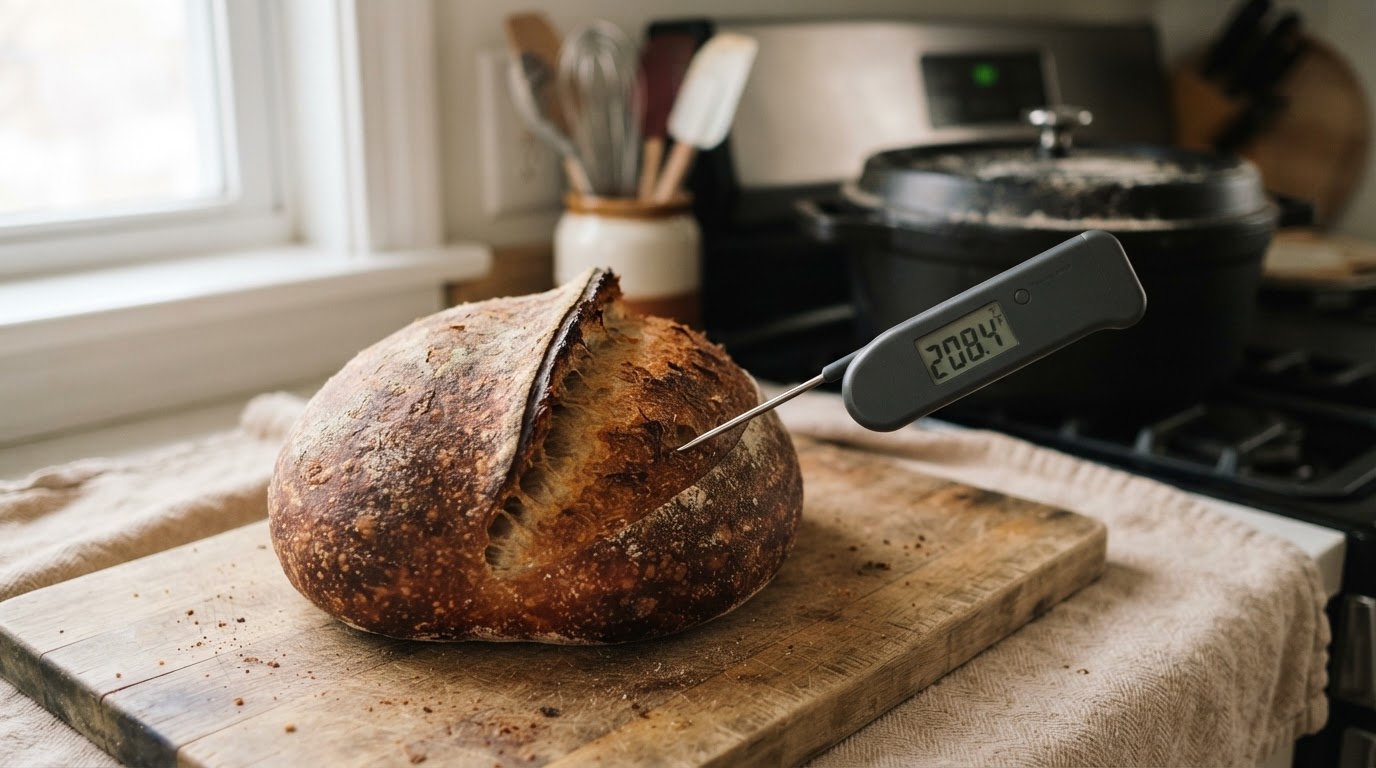
A thermometer near the vessel helps check whether the oven is running near its setting. One reading is a snapshot, not a map of hot spots across the cavity. Do not treat it as a calibrated test.
Blank bake log
Copy this table into your notes and fill one row per bake. Keep the fields stable so comparisons are meaningful.
Date | Recipe / inclusions | Vessel | Oven mode / measured temp | Rack / shield | One change | Base / crumb after cooling | Repeat result |
|---|---|---|---|---|---|---|---|
|
|
|
|
|
|
|
|
|
|
|
|
|
|
|
|
|
|
|
|
|
|
|
|
What to do with the results
If the base improves while the crumb stays properly baked, keep the shield and repeat once more before changing anything else. If the base is unchanged, choose a different single permitted change next time. If the crumb is underbaked, return to the recipe's doneness checks.
If the base is only dark or firm and the crumb is properly baked, you may not have a burning problem at all, and a heat-path change would be solving the wrong question. There is no single bake temperature or time that fixes a scorched base across different ovens, vessels and doughs, so your own repeated log entries are the only fair comparison. These are observations from your own bakes, not proof of a cause or a guarantee of repeatability.