What Philip's sandwich dough showed
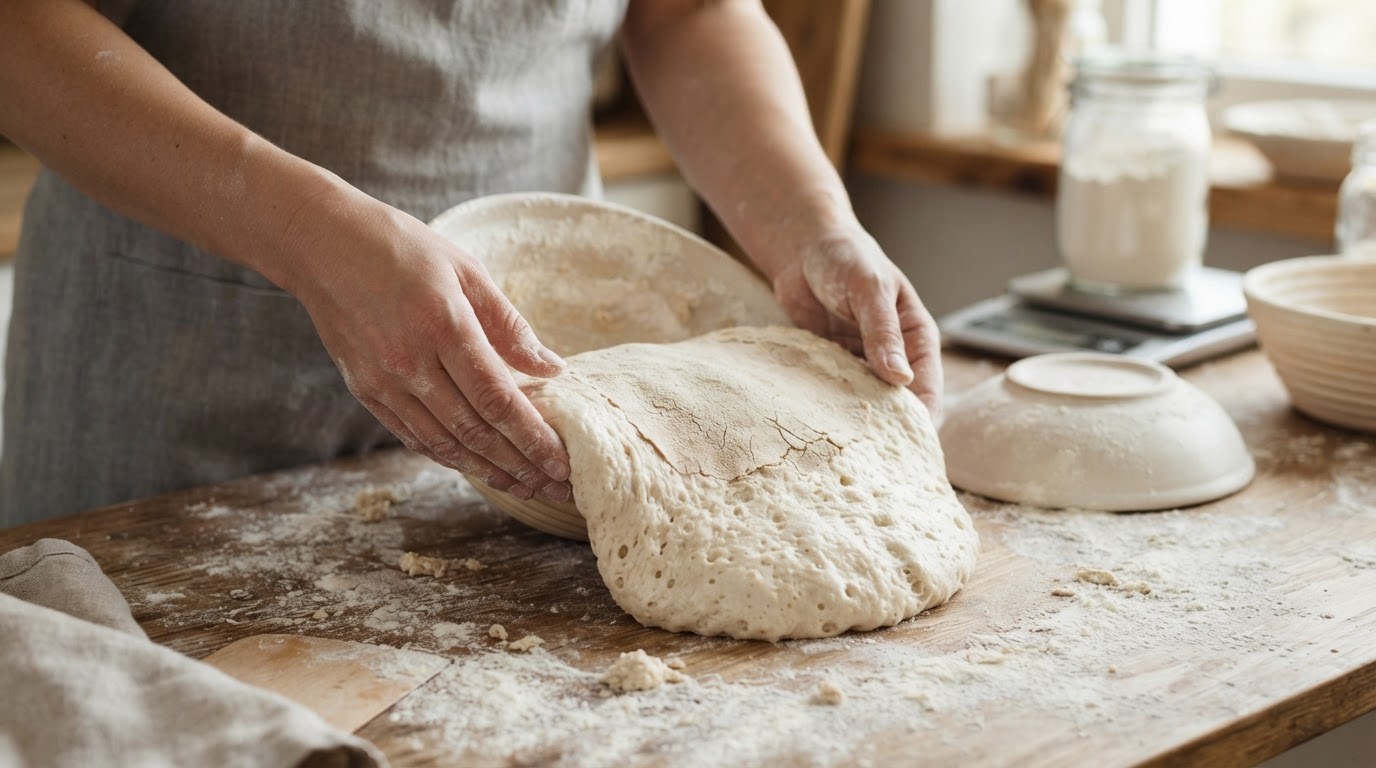
Martin Philip, a baker at King Arthur Baking, compared two halves of the same sandwich dough in an April 2023 article: one rose under a porous towel, the other under a nonporous bowl cover. The towel-covered dough developed a leathery surface that stretched poorly and would not grip itself when he shaped it. The covered dough stayed pliable. His recommendation from that comparison is a bowl cover or a fitted lid.
That was a yeast sandwich dough, not a sourdough culture, so it is not a measurement of how much water a sourdough loaf loses. It supports the narrower point that a cover passing air lets an exposed surface dry. For sourdough, the same evaporation reasoning applies with more time on the clock: a bulk fermentation can run for hours, and every stretch-and-fold lifts the cover and lets fresh air reach the dough. The longer the surface sits open, and the more that air moves, the more water it gives up.
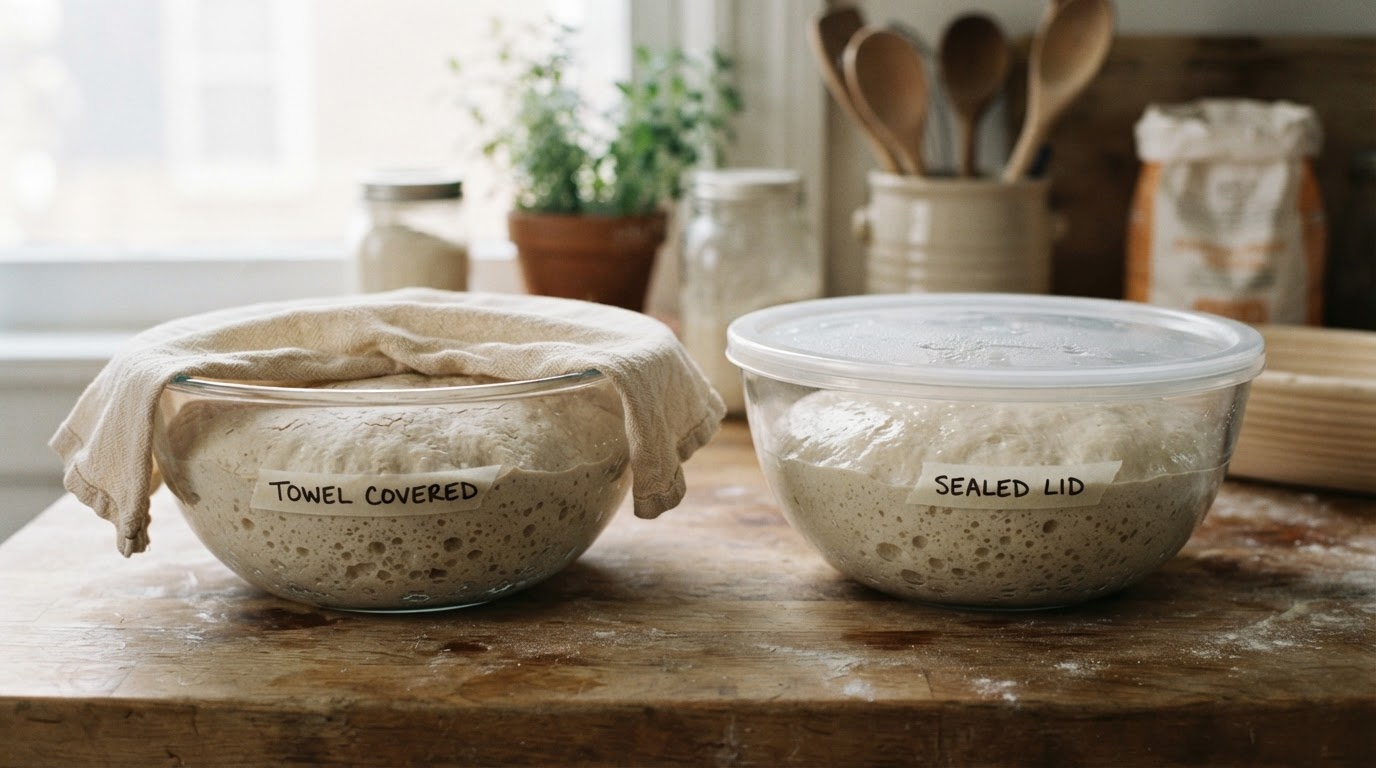
The cover that stops a surface drying
A food-safe nonporous cover is the practical answer: a fitted lid, a bowl cover, or a food-safe bag over the bowl. Plastic wrap does the same job. Cloth covers such as linen, cotton, and cheesecloth, along with paper towels and kitchen towels, all pass air, so they behave like the towel in Philip's comparison.
Leave headroom. Choose a vessel tall enough that the dough can expand without pressing up into the cover, and tighten a bag rather than letting it rest on the surface. That keeps the cover off the dough and reduces unwanted sticking when you lift it.
Replace the cover after every check and fold. Each lift lets air in, and pressing a nonporous cover back down around the rim limits how long the surface stays exposed. Keep the bowl out of drafts too, away from an open window, a ceiling fan, or the exhaust of a running oven, because moving air pulls water off a wet surface faster.
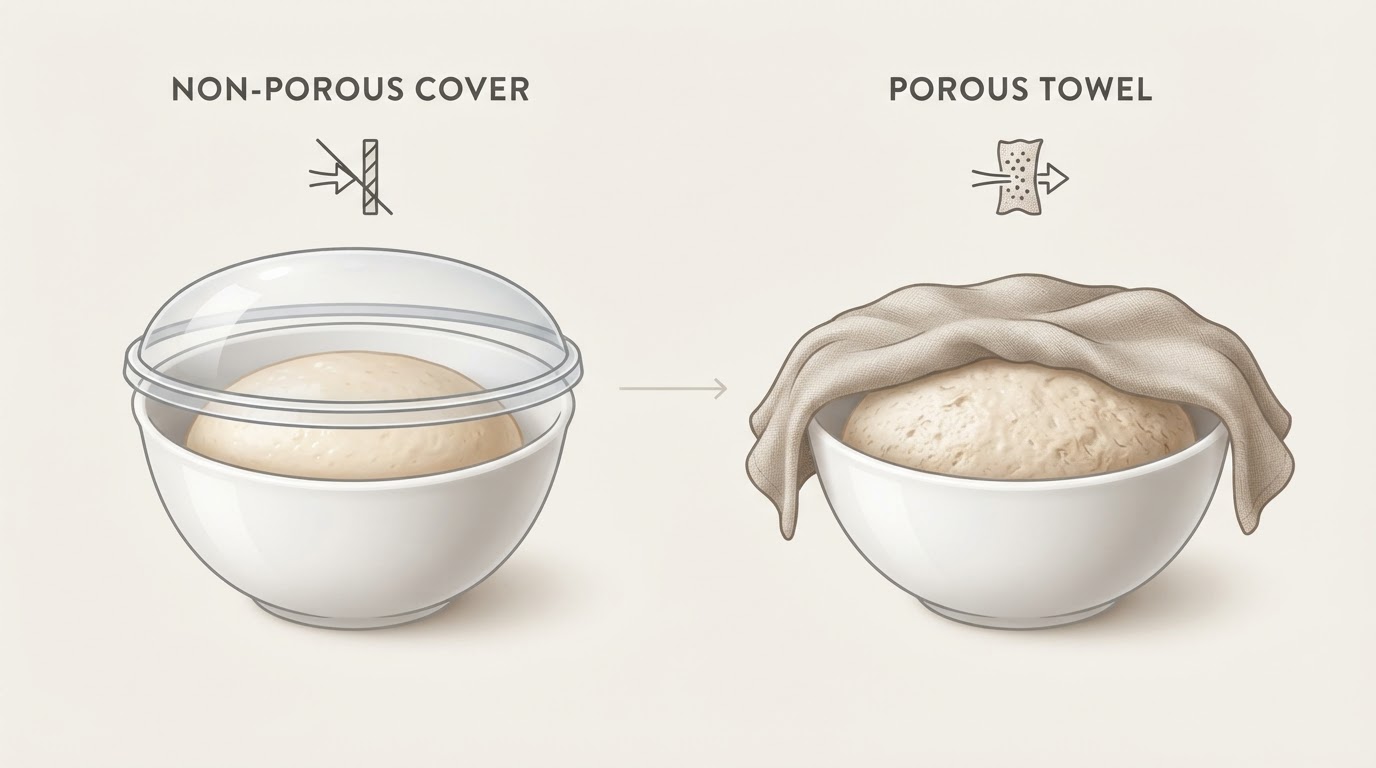
The basket needs the same barrier. A cold proof can leave the dough in the refrigerator for many hours, sometimes overnight, so cover the basket with a food-safe bag or a cover over its opening, whether it proofs cold or at room temperature.
Telling a flour dusting from a dried layer
A light coating of flour is not a skin. A flour-dusted surface, the kind you get on dough proofed in a banneton, looks powdery and comes off on a fingertip. A dried layer is part of the dough: it looks matte, feels leathery rather than floury, and does not move with the dough when you stretch a fold. In Philip's sandwich dough, the dried patches would not stretch or build tension the way the covered dough did.
The interior of the dough stays wet while the surface dries, so the dried part behaves like a separate sheet instead of a slightly stiff top. A skin can start in one spot, such as the area where a cover gaped or where the dough pressed against it, so look across the whole surface rather than only at the center. If you catch it early, while the surface is just turning matte, covering the dough properly for the rest of the bulk keeps the layer from thickening.
If the surface has already skinned over
Once a substantial leathery layer has formed, it behaves like a separate sheet, and the practical goal is to keep it from tearing the loaf apart.
Rewetting the surface, whether by misting it or handling it with wet hands, may soften the layer, but it does not guarantee that the dough will handle like fresh dough again. Forceful or repeated folds are the wrong response: each one pulls on a layer that does not stretch, and dried sections can split and crack. Keep folds to what the recipe needs and use light pressure. When you shape, press the dry patch into the dough instead of dragging it across the loaf, and if it stays separate, leave it there.
Expect the consequences at the bench and in the finished loaf: a thick patch can interfere with shaping where it sits and can show as a dry or uneven area of crust. The recipe's own schedule remains the guide for what comes next; the point to judge is how the dough actually handles, not a set amount of extra water or proofing time. If the dough also feels tight or tears at the folds before any drying has occurred, that is a separate problem, covered in this guide to sourdough tearing during stretch and fold.