Start With the Blade, Not the Proof
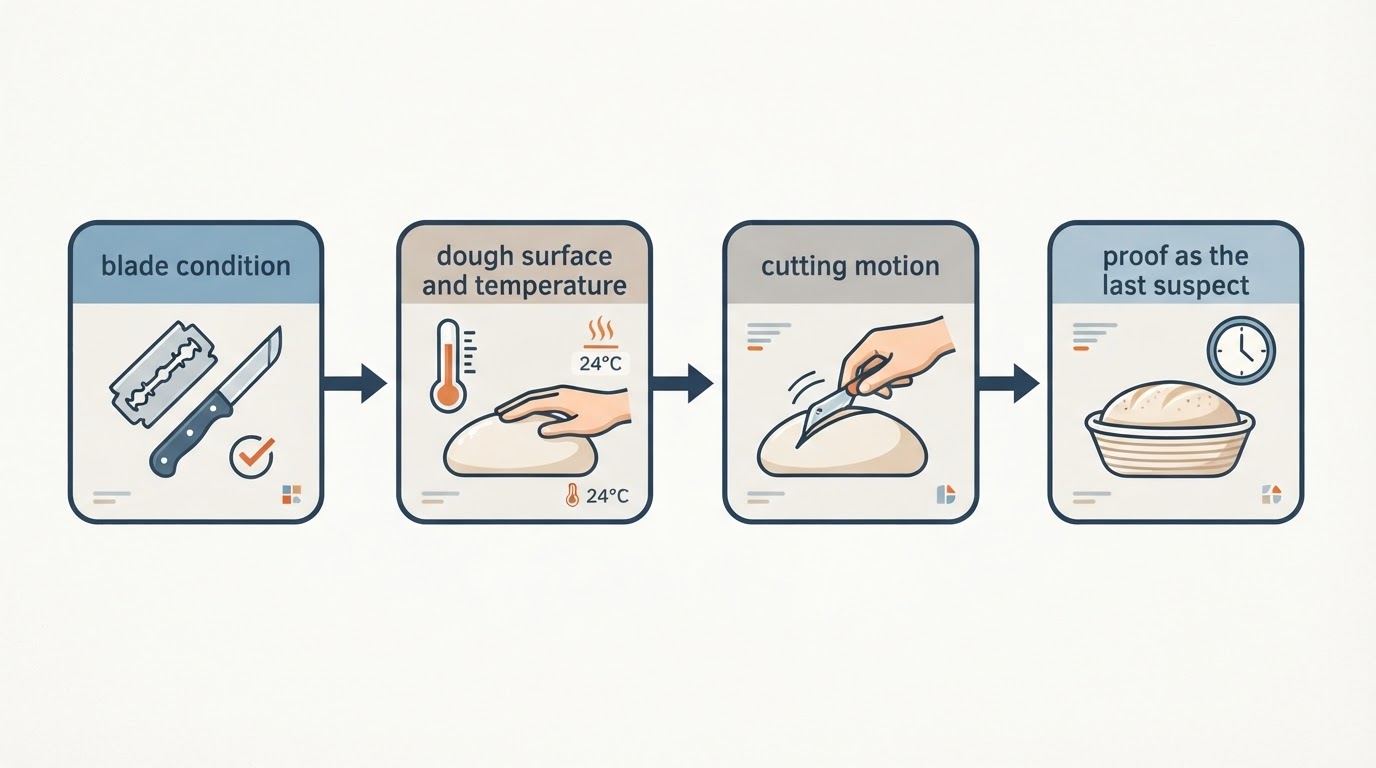
A dragging blade is usually telling you about resistance at the surface. Before you change fermentation, look at the razor. Dried dough, rust, or an edge that has dulled adds friction, and friction turns a slice into a tear. King Arthur Baking's guide to scoring bread dough recommends changing the blade often and notes that a sharp razor glides through properly fermented dough in a swift cut.
Check the seating too. A blade that shifts in the lame, or sits too shallow, rocks instead of slicing. Swap in a fresh blade and reseat it the way the holder's maker specifies; adjustment and blade removal differ by model, so follow that maker's directions rather than a universal tightening rule.
Check the Surface and the Chill
Dough temperature changes how the blade behaves. King Arthur describes warm dough as more challenging to score than cold dough proofed in the fridge, because the cold dough has a tight, firm surface that holds its shape as the blade cuts through.
A sticky, heavily floured, or seed-coated surface can also catch. If the loaf is covered in seeds or nuts, the blade snags on the additions rather than the dough. King Arthur suggests kitchen scissors for those loaves: snip in a single line, letting each cut start where the last one ended, so the surface opens in flaps. Our guide to scoring sourdough with scissors covers that method in more detail. Scissors are a useful alternate for seeded loaves, not a cure for every dragging blade.
Do not reach for more flour as the default fix; a heavy dusting can turn gummy on the blade and add drag. A light dusting or a short chill are worth trying as proposed checks, not guaranteed fixes; change one and see whether the drag actually eases before repeating it.
Make One Smooth Cut
Technique matters most when the blade is already sharp. King Arthur's guidance is to hold the blade lightly but in a firmly locked hand, then move with a single, smooth cutting motion. Sawing back and forth invites the dough to stick and tear.
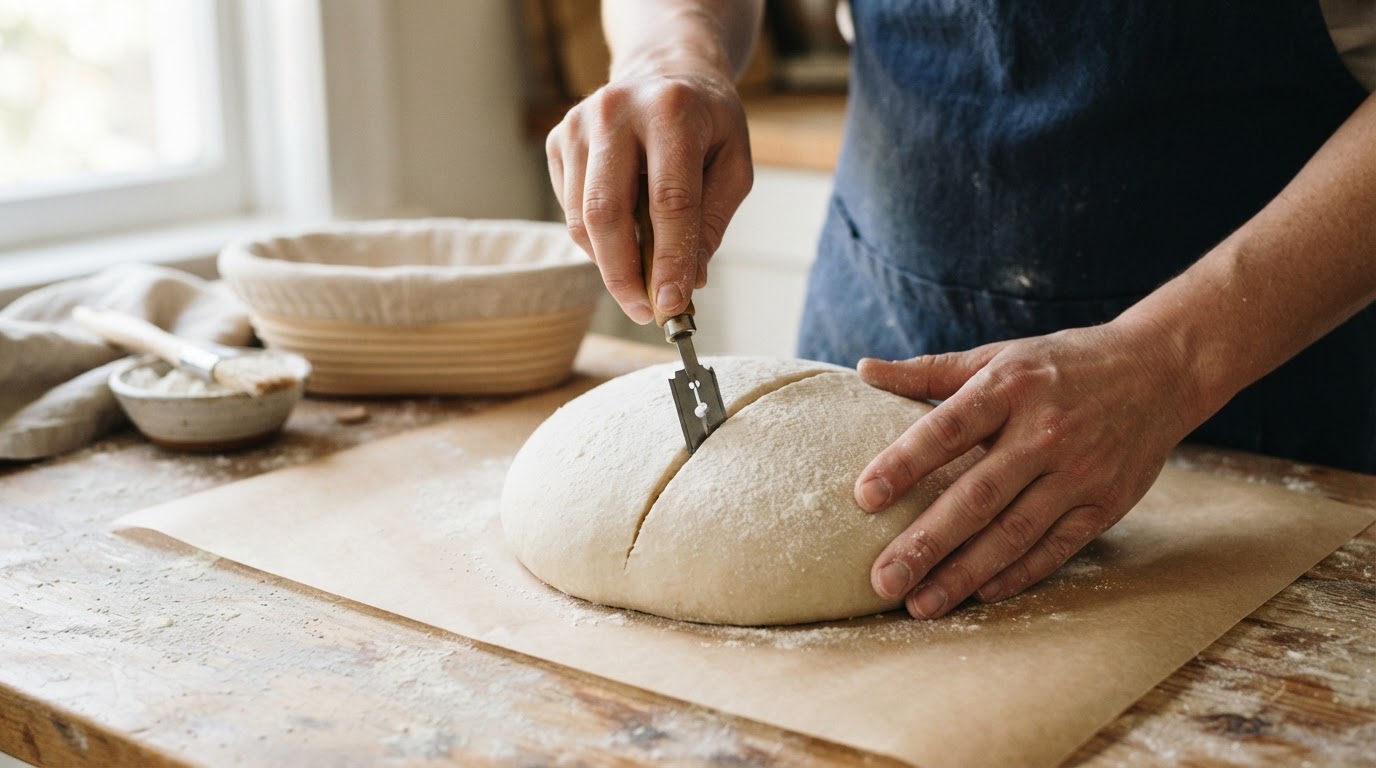
Angle depends on the shape you want. A curved blade held at about 30 degrees helps form an ear, while a straight blade held perpendicular creates a splayed opening. There is no universal cut depth; the right depth follows the dough, its shape, and the opening you want. King Arthur's guide describes a cut of roughly 1/4 to 1/2 inch for the loaves it pictures, so treat that figure as that guide's example rather than a depth for every formula.
If the blade drags mid-cut, King Arthur advises continuing the cut, because the bake usually smooths out the line. Keep your fingers out of the blade's path, and change a blade with the cutting edge turned away from your hand.
When Drag Does Point to Proof
Overproofing is real, but drag alone does not prove it. King Arthur notes that excessive dragging can be a sign the dough has proofed too long and started to lose structural integrity. "Can be" is the important part: the same symptom appears with a dull blade, a warm dough, or a seed-coated crust.
Use proof time, dough and room temperature, and the shape of the loaf as clues rather than proof. A shaped loaf that spreads and loses height after a long, warm final proof is a stronger hint than drag on its own, while the same drag after a normal, cool proof points back toward the blade or the surface. Write those three things down for a few bakes, then change one of them and compare the next result with the record instead of with a single cue.
A Quick Diagnostic Table
What you see | Check first | Next check | Change next bake |
|---|---|---|---|
Blade skips or saws | Blade edge and cleanliness | Blade seated firmly | Fresh blade, holder reseated per maker |
Dough stretches and sticks | Surface moisture | Dough temperature | Light dusting, brief chill |
Seeds or nuts tear the cut | Inclusions catching the blade | Whether scissors suit the loaf | Snip with scissors in one line |
Drag plus a slack, spreading loaf | Proof time and room temperature | Shaped height and spread notes | Shorter or cooler proof |
Change One Variable at a Time
Start with the blade because it is the fastest fix and the easiest to reverse. If a fresh blade still drags, check the dough's temperature and surface. Only after those two checks should proof time become the suspect. Change all three at once and you cannot tell which one did the work.
The goal is a clean expansion score: one decisive cut that opens where you intended, without sawing through sticky dough. Check the blade, the dough surface, and the motion before the proof.