The Short Answer: A Conditional Yes
Freezing slows the yeast and bacteria enough to pause fermentation for a while. It does not stop time completely, and it does not guarantee that the dough will come back exactly as it went in. Treat the freezer as a pause button with a cost.
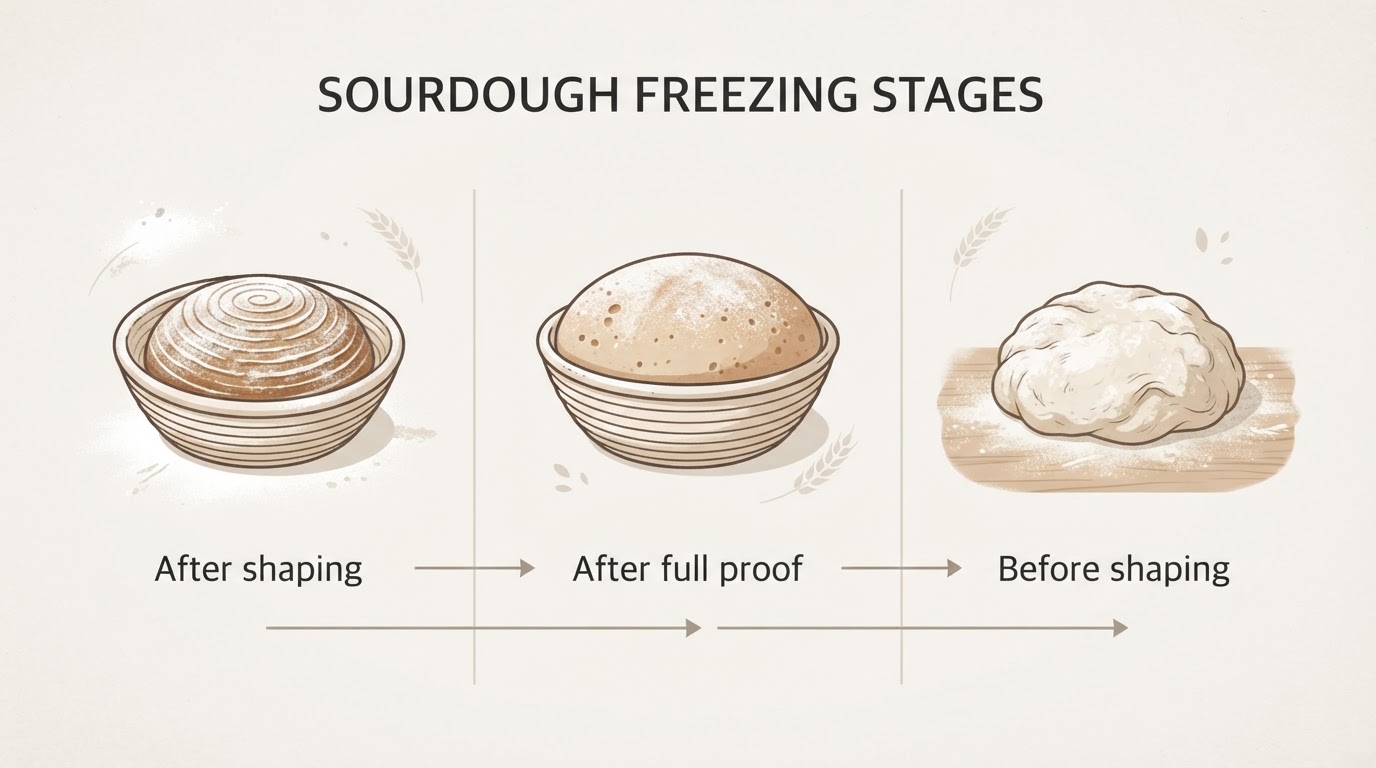
The stages people usually mean are these, and the most useful comparison comes from Breadtopia's own freezing experiments. The formula was 50% whole-grain turkey red wheat flour, 50% bread flour, 80% water, 15% starter and 2% salt. The second round used smaller loaves and a one-week freeze. That is one baker, one formula and one freezer, so the preferences below are observations from limited trials, not a validated ranking.
- After shaping, before the final proof gave the crumb Breadtopia preferred in its one-week trial. The shaped dough was frozen in its basket, then returned to a floured basket to thaw and finish proofing.
- After the final proof was the other option the trial tested in detail, and Breadtopia described it as the easiest, though not necessarily the best: the fully proofed loaf was baked straight from frozen.
- Before shaping, at the end of bulk fermentation, was the least consistent of the three in those trials. One attempt never showed convincing activity; another produced good oven spring with a gummy, under-proofed crumb.
What Breadtopia's Trials Actually Show
Breadtopia reports its own freezing experiments rather than a controlled study. The shaped, unproofed dough was frozen in its proofing basket; a few hours later the firm dough was popped out and double-bagged. After one week it went back into a heavily floured basket to defrost and finish proofing, and it was baked about 8.5 hours later, when it had warmed but had not reached room temperature. The oven spring and crumb were both good.
The fully proofed loaf was handled the same way up to the bag, then scored while still frozen solid and baked immediately from frozen. Its interior looked good if a little compressed, its crust looked unusual, and it needed 5 to 10 minutes longer in the oven than the other loaves.
The dough frozen after bulk fermentation but before shaping followed a different routine: about 20 hours in the refrigerator until malleable, a gentle shaping, then roughly three hours of proofing. That attempt had good oven spring but a gummy, under-proofed crumb. An earlier, larger-loaf version of the same approach, thawed for around 24 hours and proofed for about seven, never showed convincing activity at all.
Breadtopia's own conclusion was that freezing baked bread is easier than freezing dough, and that the shaped-but-unproofed method was the most attractive option it tested. The author also noted that only a one-week freeze had been tried with that method. You can read the full write-up, including the formula and photos, in Breadtopia's freezing dough experiment.
Three Freezing Points, Three Different Jobs
The table summarizes what Breadtopia reported in its own trials. It is not a schedule: flour, hydration, loaf size, freezer temperature and room conditions all shift the result.
Stage you freeze | What is left to do after thawing | What Breadtopia reported in its one-week trial | What the trial does not establish |
|---|---|---|---|
After shaping, before the final proof | Return to a floured basket to thaw and finish proofing, then score and bake | Preferred crumb of the round; decent oven spring; baked about 8.5 hours after leaving the freezer, still cooler than room temperature | A timetable for other loaves, flours or kitchens, or results beyond one week |
After the final proof | Score while frozen solid and bake from frozen, allowing extra oven time | Easiest method; interior a little compressed, crust appearance odd; needed 5 to 10 minutes extra | That longer storage is safe, or that texture will match a loaf baked from fresh dough |
After bulk fermentation, before shaping | Thaw until malleable, shape gently, then proof | Least consistent; one attempt did not revive, another had good spring but a gummy crumb | A reliable schedule; the author tested this twice and called it unpredictable |
Freeze after shaping, before the final proof
Shape the loaf as you normally would and leave it in a floured proofing basket. Put the basket in the freezer. Once the dough is firm — a few hours is what Breadtopia describes — lift it out of the basket, double-bag it, press out as much air as you can, and label the bag with the stage and the date.
To bake, put the frozen dough back into a heavily floured basket and let it thaw and finish proofing there. Breadtopia floured the basket generously, worried that the thawing dough would sweat and stick. That is the whole tested method: basket, freezer, bag, basket again.
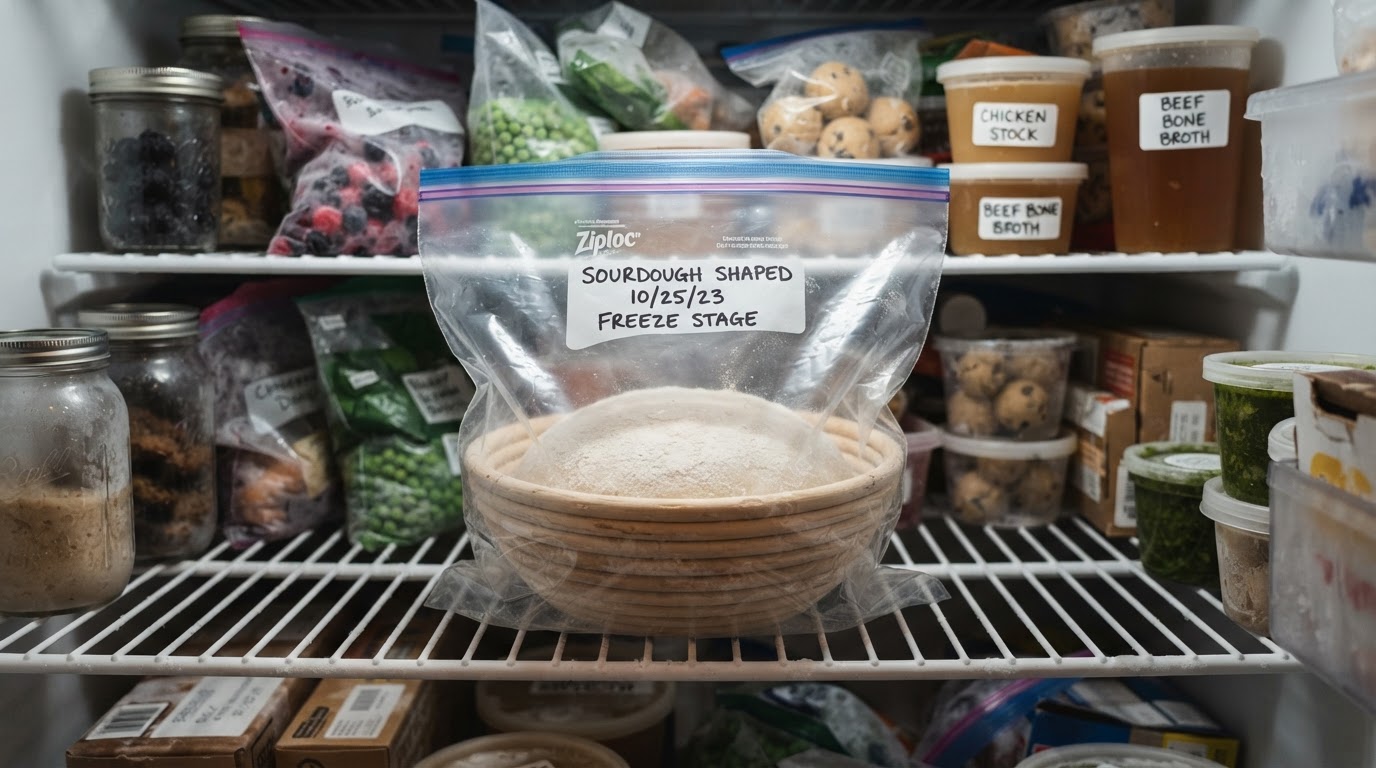
Freeze fully proofed dough
Let the loaf finish its final proof in the basket, then freeze it in the basket. When it is firm, pop it out and double-bag it the same way, with a label. On baking day there is no thaw: score the loaf while it is still frozen solid and bake it from frozen in your usual preheated setup. Breadtopia kept the lid on its baking vessel for the first 30 minutes and found the loaf needed 5 to 10 minutes longer than the others.
The appeal is that it removes the second proof from the equation. The cost is texture: the interior came out a little compressed and the crust looked unusual, which the author attributed to how steam behaves when the dough starts out frozen.
Freeze after bulk fermentation, before shaping
This is the version many people mean by "can you freeze sourdough after bulk fermentation?" Freeze the dough as a ball in a bag at the end of bulk fermentation, then thaw it until it is soft enough to handle, shape it gently, and proof.
It sounds efficient because shaping happens on baking day, but it asks a lot of the dough. Breadtopia thawed this version in the refrigerator for about 20 hours, shaped it carefully, and proofed it for roughly three hours. The first, larger-loaf attempt never regained activity and baked badly. The second had good oven spring but a gummy crumb that the author put down to under-proofing and the handling the dough had been through.
Why the Thaw Methods Are Not Interchangeable
It is easy to merge these methods into one hybrid routine. Don't. In Breadtopia's trials, the shaped, unproofed dough went straight from the freezer into a floured basket at room temperature. Only the before-shaping dough got a long refrigerator thaw, and that method gave mixed results. There is no basis in the source for carrying the refrigerator step over to shaped dough, and no claim that a cold thaw is gentler. They are different protocols with different dough states, packaging and handling, and a step that belongs to one is not automatically right for the other.
Thawing and Proofing: Watch the Dough, Not a Number
There is no single internal temperature or poke result that tells you the dough is ready. In the trial, the shaped, unproofed loaf was baked while it was still cooler than room temperature, and the fully proofed loaf went into the oven frozen solid. Both went into the oven as they were, and both produced bread. A fixed temperature target or one poke response would have misjudged at least one of them.
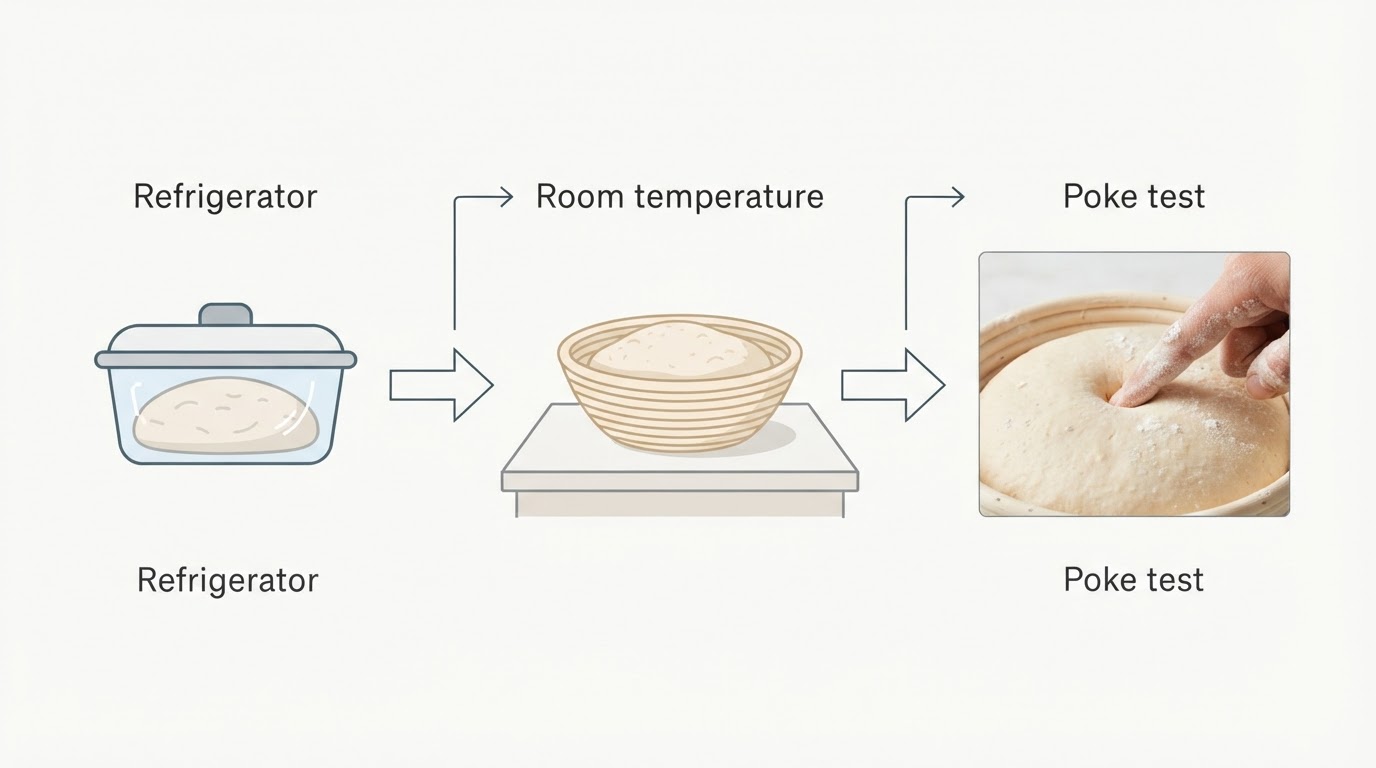
What is worth watching:
- Expansion since the freezer. The dough should be visibly larger than it was when it came out. In the trial, the shaped loaf had expanded a little in the basket before it was baked.
- Surface activity. A few bubbles and a slightly domed top are more encouraging than a tight, smooth skin, though a floury, cold surface can hide what is happening underneath.
- How it feels. Press gently with a floured finger. A tight, fast spring back suggests the dough is still early. A slow, partial spring with a small indent left behind suggests it is relaxing and expanding. A fragile feel with no spring can mean it has gone far. None of these is a guarantee on its own.
- Your recipe and stage. A dough frozen after shaping still has its final proof ahead of it. A fully proofed dough has none. Judge the same cues differently depending on which one you are holding.
Timing is genuinely uncertain. Breadtopia's shaped loaf took about 8.5 hours from freezer to oven, and the author expected longer in cool seasons. Smaller loaves, warmer rooms and more active starters will move faster; a cold kitchen, a large loaf or a long freeze will move slower. Write down what you did and how long it took, then use that as your own baseline rather than treating any published figure as a target.
If the dough sits at the same size for hours, give it more time before making a decision. Fermentation after freezing can restart slowly and unevenly, and a dough that looks stalled at hour four may still move at hour eight.
Freezing Baked Bread Is the More Predictable Option
If your goal is simply to have sourdough ready later, freezing the baked loaf is the lower-risk choice, and it is what Breadtopia recommends after running these experiments. It removes the thaw-and-proof uncertainty entirely, and you can judge the reheat by feel and smell rather than by a fermentation cue.
Cool the loaf completely, wrap it airtight, label it and freeze it. The site's guide to freezing a loaf of sourdough bread covers cooling, wrapping, thawing and reheating in detail, so this guide will not repeat it.
Keep Starter, Levain, Dough and Bread Separate
These four things are often lumped together, and the advice does not transfer between them:
- Living starter is the culture you feed. Freezing a portion is a backup, not a guarantee that it will revive.
- Levain is a preferment built for one bake. Its freezing behavior belongs to that build.
- Raw dough is the subject of this guide: mixed, shaped or unshaped dough that you want to bake later.
- Baked bread is a finished loaf, with its own wrapping, thawing and reheating rules.
If you are trying to preserve the culture rather than pause a loaf, read freezing sourdough starter instead. It explains the difference between a frozen backup, a dried backup and an active jar, and why a recovery check beats a calendar.
Limits: What This Advice Covers
This guide is about a plain, lean sourdough loaf. Enriched doughs — brioche, babka, challah and similar — contain butter, eggs, sugar or milk, and dough with perishable fillings needs recipe-specific food-safety handling. Freezing does not reset food safety.
A few other limits are worth stating plainly:
- Freezing does not guarantee that every yeast and bacteria cell survives. Expect variability, especially after longer storage or rough handling, and do not read one good result as proof of what will happen next time.
- The trial above tested a one-week freeze. Breadtopia was not confident about longer storage for the shaped dough, and nothing here should be read as a storage limit or a safety guarantee.
- Avoid refreezing thawed dough as a precaution. The trials did not test repeated cycles, so claims about exactly what they do to structure or fermentation would be speculation.
- Discard dough that smells off or shows mold. Freezing is not a sanitizing step, and it does not rescue dough that was already spoiled.
- This is not a new recipe. Use your own formula and your own judgment about your starter and your kitchen.
If a dough never shows activity after thawing, do not assume it is safe to bake simply because it spent time in the freezer. Check it first: smell, appearance and how long it sat before freezing all matter. A dough that is sound but sluggish may still work in a recipe that suits a dense, partially proofed dough, such as a flatbread or focaccia, but that depends on the dough's condition and on a recipe built for it. It will not behave like a normal loaf, and no one can tell you from a distance whether a particular dough is safe.
Your Freeze-Later Checklist
- Pick the stage deliberately, and treat Breadtopia's one-week trial as one data point: shaped and unproofed gave its preferred crumb, fully proofed was its easiest, before shaping was its least consistent.
- For shaped dough, freeze in the basket, bag it once firm, and return it to a well-floured basket to thaw and finish proofing.
- Label the stage and the date, and keep the one-week window in mind as the only duration actually tested.
- Judge progress by expansion, surface activity and how the dough feels, alongside your recipe and stage — not by a single temperature or a fixed poke response.
- If you want convenience rather than a project, bake the loaf first and freeze that instead.
If you track one thing, track the dough's behavior rather than the hours. A note about how long the thaw took, how much it rose and how the crumb turned out is more useful for your next bake than any fixed number.